

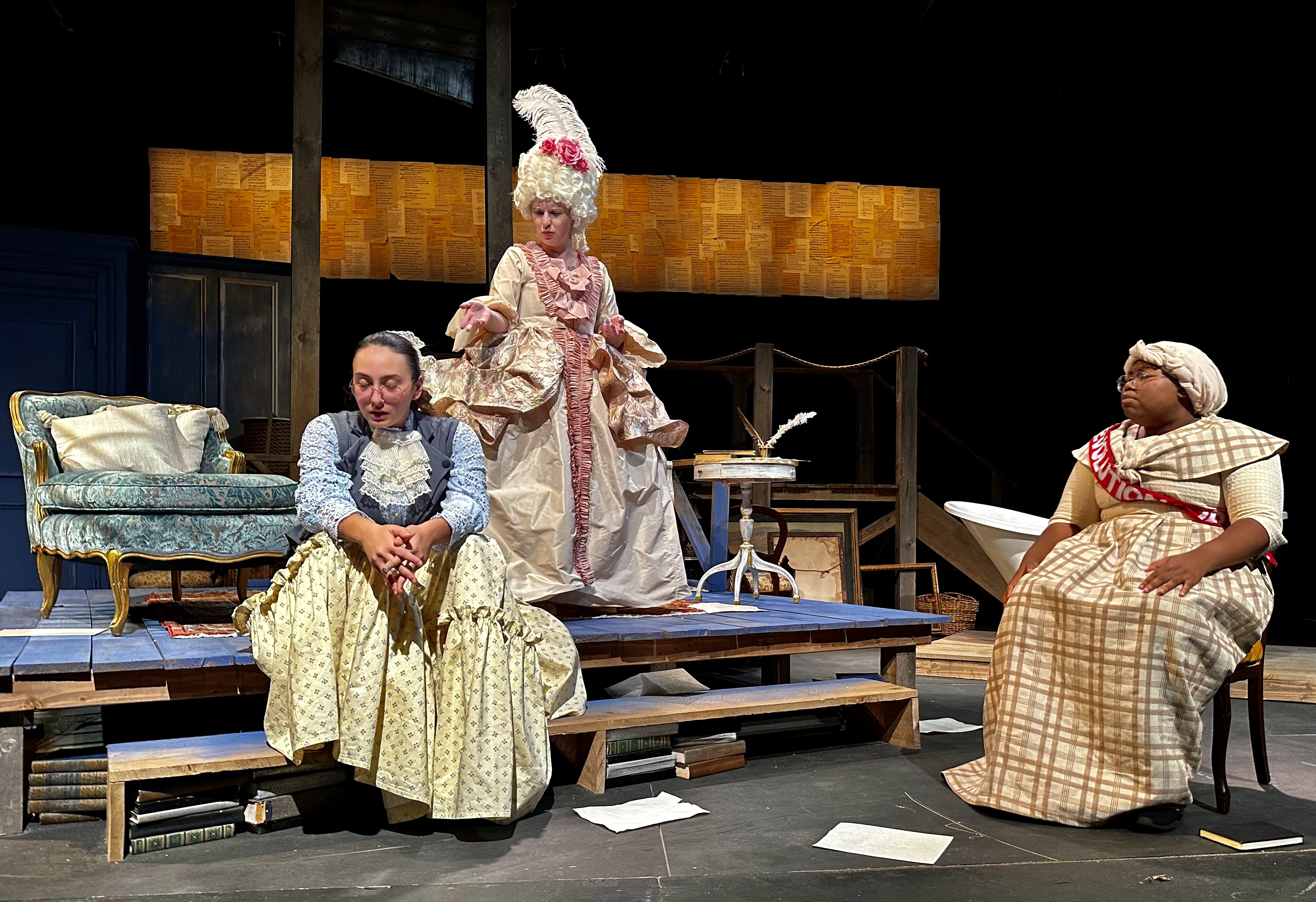
Davidson Hall stands nestled in the western corner of the New Britain campus of Central Connecticut State University. The theater building is filled with practice and performance spaces for choral arrangements, band rehearsals, and theater productions. Inside one of these spaces on a chilly fall night, four actresses are on week three of rehearsals for The Revolutionists, the theater department’s fall play. The actresses are spread out in their street clothes within the room texting on their phones, waiting for director Nick Roesler.
He strides briskly into the room wearing a gray zip-up, blue denims, and a pair of trainers, his brown hair spiked. A smirk etches onto his face as he quickly sets his tablet down on a wooden riser and bookbag on the floor. “Hello, hello,” he brightly greets the actresses as they gather in a circle around him. They begin with considerably long warm-up exercises, such as stretching, shouting, chatting, and singing. Sometimes serious, sometimes playful, they set the tone for the rest of the night as they prepare to assume their roles.
The Revolutionists is a bold and irreverent French Revolution–era play set in 1793, centered around four strong women fighting for what they believe is right. There is the ditzy yet hopeful playwright, Olympe, based on playwright Olympe de Gouges; the vengeful assassin, Charlotte, based on actual assassin Charlotte Corday; a steadfast Haitian rebel, Marianne Angelle, based on real women who protested slavery in Haiti; and a profligate former queen, Marie Antoinette, based on the last queen of France. Olympe sets out to write a play, hoping to garner fame and success and etch her name into the history books. She meets three other women along the way, some she knows, all hoping to make an impact on the misogynistic patriarchy denying them their liberty. They soon find that life is not a fairy tale, and their actions quickly catch up to them, sealing their deadly fate.
“It doesn’t have a freaking love story in it. It’s about women being badass and showing you what they can do. That’s it. There’s nothing distracting from that.”
The play was written in 2016 by Lauren Gunderson, so the dialogue is modernized for the twenty-first century. It features a fast pace, tongue-in-cheek, and often fourth wall–breaking style, with hearty helpings of sassy wit. The brash and offbeat production ends with a haunting musical number, strictly a capella, placing an evocative period on the play.
“You feel like you’re a part of something, like this is your team,” says senior Aria Adee, who plays Olympe. She strides across the rehearsal space with little effort and dives into her character wearing gray sweatpants and a hoodie. “Then afterwards you feel like you’ve done something, and you’ve made work like this. I like doing social justice theater. You feel like you’ve made a difference in some way, putting something out.” She goes even deeper, expounding on how much this particular play means to her. She ties in the recent presidential election, alluding to Kamala Harris’s defeat. “Have we even made any progress? Sometimes that’s how you feel. Stuff like this just reminds you that the job’s not finished. There’s always more to do.”

The way the four actresses recite their lines is sharp and direct, and the energy throughout the room mirrors that as they all work in tandem, rehearsing the show. The actresses are deep into their characters at this point, having already begun to master their characters’ mannerisms, understanding dialogue, and the blocking of the show, despite still rehearsing with scripts in their hands. There’s a sense of playful tension in the air, playing into the piece’s meta humor amid the dark revolutionary themes as the four of them bounce off of one another. They work around temporary props found in storage rooms like office chairs and black chests. Roesler occasionally calls out to an actress when he feels they’re out of place, asking, “Where are you on stage?” Stage direction is paramount to the performance, and he makes sure to hammer down.
From start to finish, Roesler helms the ship and never lets it steer off course. Even when not actively participating in the scene, he’s constantly moving, matching the spirited passion of his actresses, always offering direction and encouragement. He’ll ask to retake a scene in a different style; loosen or tighten up, whatever he feels the scene calls for, often letting his actresses run with what they feel is right.
The Revolutionists is hardly Roesler’s first foray into the directing world, however it’s not something he does frequently. “The last thing I directed was Eurydice. That was a year ago, but before that I hadn’t directed anything for ten years.” He has nearly twenty years of acting and performance under his belt since graduating with his master’s from Northern Illinois University, even studying at the Moscow Art Theater in Russia. He also knows Lauren Gunderson personally, having worked with her on a previous play called Silent Sky.
Roesler was excited to handle another play by Gunderson, and is passionate about the work he and his actresses are doing. “They’re doing really strong work and they’re doing it on a show that has some really great things to say about the nature of art, the nature of revolution, a woman’s role in that, and how seriously or not it was taken at that time and even now. And it’s been a real pleasure to be part of this process.” As for Gunderson’s tackling of feminism, the patriarchy, and the oppression of women during a time of terror and revolution in France, Roesler adds, “Unfortunately, you see at this particular juncture, just how the voices of women are treated and their representation as well. But it’s something that I’ve been excited to explore.”
Explore they have, as the next week rolls around, now halfway to opening night. There is no warm up, and the actresses are now off-book and the props period-appropriate. Roesler paces frantically at the front of the room, eager to get underway. Costumes begin coming together for the play as well. They finish with scripts in hand, re-reading certain scenes before tucking the pages away in their bags, and begin full run-throughs of the play. The actresses hit their marks. Four strong women fight against male oppression with a little humor.

So much has improved in such a small amount of time. Lines are practically memorized from start to finish and the actions and emotion of each actress is refined. Roesler looks forward to opening night on December 4. “It’s been a real pleasure to be part of this process. And if people are interested in something that will entertain them, that will make them laugh out loud, and also might jerk a tear or two, then it’s definitely worth coming and checking us out.”
The cast and crew are finding their groove, and before they know it, they’ll be ready to perform. Adee said it best, “It doesn’t have a freaking love story in it. It’s about women being badass and showing you what they can do. That’s it. There’s nothing distracting from that.”
The night has arrived. Audience members take their seats in the Black Box Theatre, located in Maloney Hall, while French orchestral music plays. Bright spotlights illuminate a chair, a couch, and multiple end tables littered with books and script drafts atop a rickety wooden floor. A chipped blue door lurks in the back, the metaphorical revolving door of the four actresses. This is where the revolutionists convene, and looming ominously in the background is what awaits them: the guillotine. Seated stage left is director Nick Roesler, prepared to see the fruits of his labor. Then every light in the theater goes out, shrouding it in darkness.
The play begins. The entire play felt like one long conversation. The actresses lived and breathed their characters, each of them hitting their stride, never missing a beat. Olympe shouted loud about her playwriting prowess to anyone who could hear. Marianne cried out for revolution and for her husband, now lost to war. Charlotte fought for what she believed was justice to a permanent fault, and Marie, even in the face of death, remained the last true queen of France. As dramatically as it began, with an engrossing monologue and the loud thunk of the guillotine’s blade striking the wooden platform, the play ends in a similar fashion. Olympe started with the struggle to find a story, one that didn’t involve executions or puppets or stereotypes, and instead wrote one based in reality, one that people would talk about for centuries to come. By the end, she realized her story is indeed one of fiction, having never even met the other three revolutionists. Yet to Olympe, it was more real than anything she could’ve experienced in her lifetime. Now on the chopping block, she stared out at the audience and uttered her final line: “As the blade fell. And a story begins.”
Jack Grimord is a staff writer for Blue Muse Magazine.
Featured Image: Actresses Aria Adee, Ceara Sweet, and TJ Jones in a scene from The Revolutionists, taken by Nick Roesler.
Thanks for the full account of the play. I need to get to CCSU theater more often!