

In early April 2024, I visited the home of my dear friend Omar Majdoub. He welcomed me into his suburban home, where I was introduced to his mother, Reem Jasser; his father, Mohammed Majdoub; and his two sisters, Hadeel and Menna. After immigrating to the United States in 2000, Mohammed landed a career as a biomedical engineer, and Reem is a school teacher, currently studying for her master’s degree in education. Hadeel works at Newington Parks and Recreation, Omar is a software engineer, and Menna is a college sophomore.

The Majdoubs greeted me warmly. Their hugs pulled me inside, and a handshake from Mohammed steered us to a couch. We had twenty-two minutes until we could break our fasts. I had not eaten since before dawn, when I woke up to eat dates and chug water. Fasting strictness differs between families, so to honor the Majdoubs, from dawn to dusk I did not eat, drink, or engage in any sexual relations. Negative thoughts and energy were to be avoided, as pure and positive emotions were needed for the fast. Reem capitalized on these minutes to exhibit her home decor. The most important symbol during Ramadan, a lantern, was on their coffee table, next to a lunar tray. Reem’s tatreez, تطريز, a traditional Palestinian embroidery, was mounted above their couch. Reem guided me to the mantel. She moved Omar’s massive graduation picture, and revealed her favorite painting from Palestine: two women in the dusty street against a stone wall, one with a wound on her hand.
Eight minutes before sunset, Mohammed, Hadeel, Omar, Menna, and I gathered around the kitchen to watch Reem flip maqluba, مقلوبة, meaning “upside down,” their favorite and most popular Palestinian dish. An apron covered her gray sweater as she held the circular pot in her right hand, and the curved tray in her left. She slapped the two together, and swung her right arm over her left, flipping the dish. The family inhaled in anticipation as Reem giggled and lifted the pan, revealing a perfect mountain of rice, potato, eggplant, carrot, and chicken. They exhaled and cheered.
The oblong table was set with white squircle plates and bowls. Acopa carafes with water, orange juice, and Vimto (a grape, blackcurrant, and raspberry drink) sat at Omar’s end of the table. One of the two miniature wicker baskets for date pits also sat at his end next to fattoush, فتوش, a Lebanese salad. Ceramic dishes with plain yogurt, jalapeños, olives and pickles, egg rolls, and empanadas were spread across the table. The maqluba, topped with roasted almonds, rests in the center. A simple soup with Cheerios-shaped noodles filled the bowls. The Majdoub men sat at each end of the table. Hadeel beside me, Reem and Menna across the spread of food. We waited. Talk bounced between the Governors Ball lineup to Iran’s threats to Israel in retaliation for the airstrike on the Iranian embassy complex in Damascus, Syria.
The current war in the Middle East weighs heavily on the family. They wrestle with being disconnected from their homeland, especially during the holy and celebratory month of Ramadan.
Adhan, أذان, the call to prayer, played from the television at 7:19 p.m., marking the break of the fast, and the allowance of iftar, إفطار, the feast at dusk. We reached for the dates first, the pits clanking in the wicker basket. Omar rolled up the forest-green sleeves of his “Free Palestine” hoodie and refilled his water glass. Across the table, soup was eaten in record time, and fattoush filled the bowls next. Juicy tomatoes and cucumbers burst in my mouth, supplying me with what felt like the eight cups of water I was supposed to drink in a day. Reem scooped heaping amounts of maqluba onto everyone’s plates, ensuring there was a little bit of everything good.
“That’s good, thank you,” I said to Reem, but she continued serving with a smile on her face. “Just know, when you say ‘stop,’ that means you’re getting two more scoops,” Hadeel joked. Muffled laughter rang with the clanking of silverware.
Once some sustenance reached everyone’s stomachs, the small talk continued. The family felt it was important for me to truly understand why we fasted from dawn to dusk, and why Muslims practice Ramadan. Hadeel began by explaining that fasting encourages spiritual discipline and growth. Muslims practice self-restraint and gratitude as they remember the poor and hungry. Ramadan is the month that the Holy Qur’an, القرآن, was sent down from heaven, so fasting is an act of worship that brings them closer to God. Reem reached toward me and added that it also brings them together culturally and socially.
In the Middle East, it is typical to be woken up around five o’clock in the morning to people in the streets banging on pans and buckets to gather everyone to enjoy Suhoor together. Suhoor,سحور, is the feast eaten before the break of dawn during Ramadan. Over Zoom, I spoke to Oraib Jasser Alramahi, Reem’s younger sister, who lives in Jordan. She said there are daily gatherings in the streets before dawn. Restaurants leave their chairs and tables outside so that everyone can eat together. The streets are usually lined with lights and decorations, “but this year was different. There’s no lights. We used to eat a lot during Ramadan. Now we’re ashamed,” she said. “Our people in Gaza are under starvation.”
“I think about my grandparents, my great-grandparents, my great-great-grandparents, my ancestral line has all been on that land, and my branch of that is disconnected. It’s such a strange feeling to me.”
On October 7, 2023, just before seven o’clock in the morning, a Hamas-led terrorist attack on Israel from the Gaza Strip breached the separation wall that Israel had built twenty-one years earlier, killing around twelve hundred Israelis, and kidnapping around 240. The Israel counteroffensive has since occupied the Gaza Strip and West Bank. On May 6, the Gaza Ministry of Health affirmed that at least thirty-four thousand Palestinians have been killed, including over twelve thousand children, and over seventy-eight thousand Palestinians have been wounded.
The Israeli-Palestinian conflict started long before October 7, of course. The Arab-Israeli war began seventy-six years ago, in November 1947, and it intensified after Israel declared its independence in May 1948. Egypt launched an aerial attack on Tel Aviv, then Arab armies from Lebanon, Iraq, Syria, and Egypt invaded southern and eastern Palestine. The war ended in July 1949, with an Israeli victory leading to Israel controlling all of the Negev in southern Israel, except for the Gaza Strip. The Israeli occupation left over seven hundred thousand Palestinian Arabs, about half of the population, displaced. Israel refers to this war as its War of Independence, while Arabs refer to the war as the Nakba, نكبة, meaning “catastrophe.”
The Six-Day War followed in 1967. Israel staged an air assault, destroying more than 90 percent of Egypt’s air force. This left the Egyptian army vulnerable, so they brought in allies, Jordan and Syria. On June 7, the UN Security Council called for a ceasefire, and it was immediately accepted by Israel and Jordan, and Egypt accepted it on June 8. On June 9, Israel launched an assault on the Golan Heights, defeating the Syrian armies. Syria accepted the ceasefire on June 10. By the end of the war, Israel had taken control of the Gaza Strip, the West Bank, the Sinai Peninsula, the Old City of Jerusalem, and Golan Heights.
Mohammed’s family was expelled from Palestine during the Six-Day War. “In 1967, my mom was pregnant and in labor. They lived in forests where there’s no medical supplies. And she delivered a baby in the middle of nowhere.”

Reem and Mohammed, both fifty-three years old, arrived in Connecticut a year after Hadeel was born in Amman, Jordan. “We always seek a better life for us and the next few generations,” Mohammed said. Jordan is a small country with limited resources, so financially, they chased the American dream. They do their best to participate in their local community so they can establish a foothold in their adopted country. Reem feels connected to the community through her work as a public school teacher. “Palestinians are very involved people,” Mohammed added. They also volunteer at soup kitchens and attend Palestinian protests.
Mohammed pushed up the sleeves of his light blue paisley buttoned shirt as he recounted his desire to work in hospitals again. “I want to be a part of the society, helping somebody, or at least improving patient lives, helping somebody’s life.”
Though they are grateful for their lives in Connecticut, Reem struggles with drifting too far from their culture, especially now, with their homeland in crisis. “Now we feel pain in our spirit.” Her voice softened. “We can’t do anything, we can’t send money. It hurts, it’s hard to describe.”
“I wish I can do something for them. Not because I’m Palestinian, because I am a human being.”
Orange slices and popcorn were the last items to be passed around the table. Reem twirled the Turkish coffee grounds at the bottom of her orange floral ceramic mug and watched the dregs as Mohammed spoke about their three children. “They don’t ever want to hide their identities. They’re so proud of it. It’s natural with them, and they want to maintain it.” Reem and Mohammed glanced at each other. “As parents, that makes us very proud. I mean, they go to college, they have friends, they have a traditional American lifestyle, but at the end of the day, they have roots.” In December 2023, they all returned home to Jordan. “They’re proud of where they are [from], they’re proud of their identity, and that’s something you cannot describe.”

“There’s nothing like it,” Hadeel said, about the trip to their homeland. She released her gold Palestine state necklace and it landed on her deep blue sweater. She leaned on the table and spoke passionately with her hands. “It’s a feeling you can’t describe, but it’s not something physical. It’s something in your soul, a soul pain.” She poked her chest. “Where it’s so deep within you, and you can’t do much but swallow the pain and just keep going. But when you go back home, in Jordan, and you’re surrounded by your family, it’s just something you can’t describe. It’s beautiful. It’s amazing. And if I have the opportunity, I would go back to Jordan in a heartbeat.” She sat back, pride radiating off of her smiling face. She told me that “you will know a Palestinian is Palestinian before you know their name.”
Twenty-five-year-old Hadeel differs from teenage Hadeel. She attended Newington schools that lacked diversity and discussions of holidays of different religions and cultures. (Seventy-two percent of Newington is Caucasian.) She was quiet in the classroom because she “didn’t want to get bullied.” She was also the victim of Islamophobia.

Omar also struggled growing up in a predominantly white town. “I grew up with this stigma and it was something I had to learn how to deal with.” Being Middle Eastern, brown-skinned, and a follower of Islam, harsh labels found their way to Omar. “I’m not a bad person, why are you automatically assuming that I could potentially be?” His eyebrows furrowed behind his clear round glasses. Omar fortunately found friends who he described as educated and aware. He felt safe and comfortable to discuss Palestine with his friends. “[I can] show my social circle why it’s important to look into this matter, and why it’s important to support this matter.” He glanced at the Palestinian flag that hangs over the balcony behind him, the green matching his sweatshirt. “Because it’s not only supporting the Palestinian people, it’s supporting the right to be a human being.”
Omar is stunned by how the West judges an area of the world about which they lack much knowledge or experience. “It’s really weird seeing the mentality that people have over here towards a part of the world they don’t even know.” While grateful for the life he lives in Connecticut, he misses his homeland. “That’s where I would be growing up right now if none of this ever happened. I wish I could be there right now.” His fingertips thudded on the table as he leaned forward. “I wish I could be part of my land, but I’m not.” He acknowledged the vast differences and struggles that his life would have if he lived in Jordan, “but I would still be connected physically to my roots.”

Though nineteen-year-old Menna is the youngest, she also had to navigate a lack of diversity growing up. She found a diverse friend group in secondary school, but the school system lacked diversity overall. “I started the diversity club in my [high] school to solve some of those issues.” She fidgeted with her turquoise necklace. She has to remind herself that “it’ll be better for me to put it out there and see where you stand. Because if you don’t stand with the same morals that I do with this situation and my people, we cannot be friends.” She proudly shares news about Palestine on social media–however, she was shadowbanned. This is a practice where media platforms limit the audience a post will reach to suppress topics they believe are inflammatory.

When I spoke to Oraib, Reem’s thirty-three-year-old sister in Jordan, she acknowledged the differences in how her family in America is affected by the current state of the Middle East. In America, “there is a lot of hate speech against the Arab, [a lot of] Islamophobia. Alhamdulillah, الحمد لله, we don’t have this in Jordan.” Her laptop bounced on her lap as her hands waved with her words. Even living in Jordan, Oraib feels disconnected from her home. “Imagine you live all your life not knowing what the homeland means. You will never have the real feeling of knowing what home means.” There was a long pause after I asked the tricky question, “Is Jordan home for you?” After a deep exhale and a smile, she said, “To be honest, I love Jordan. Amman is everything: my family, my friends, the places I love. It’s beautiful, it’s the place I was raised. But home is Palestine.” Nothing runs deeper than the roots and spirit of the Palestinian people.
“I think about my grandparents, my great-grandparents, my great-great-grandparents, my ancestral line has all been on that land, and my branch of that is disconnected. It’s such a strange feeling to me,” Omar said. “It’s like I’ve been cut off from all this beauty, all of this lifestyle of my people. I miss something that I never had. I wish I had what they had, but I don’t. It’s something that’s been taken away, and it sucks, it’s painful.”
Every day, the family is reminded that Palestinians are struggling to survive. A feeling of guilt circulated around the table. The privilege of living in America is an emotional rollercoaster for Hadeel. “I have a sense of guilt very often. Sitting here, eating dinner, you always feel guilty. Because I’m a Palestinian outside of Palestine, I have freedom. I have safety.” Omar doesn’t “think it’s my right to get emotional over it because my emotions have nothing to do with the struggles of the people over there. They’re the ones facing it.” Similarly, Menna feels “guilty for feeling like it’s affecting me so much,” when there are people living through the atrocities every second of every day. For Reem, watching the news from Gaza and hearing the stories hurts deeply. “I wish I can do something for them. Not because I’m Palestinian, because I am a human being.”
“It’s a feeling you can’t describe, but it’s not something physical. It’s something in your soul, a soul pain.”
Pushing against this guilt and anguish, the family has hope. Mohammed recalled the stories of Palestinian people taking their keys with them during expulsions from their homes: “We still have the keys to our house because we know we will return,” Omar said. “It’s our right. That’s our home. I don’t care what the law says. I don’t care what borders say. We belong there. That’s where we are. That’s where we were raised. I feel like nobody can take that away from us.”
Oraib is optimistic and believes that “the next generation is the generation that will return back to Palestine, [and] I will help to be a part of this story.”
After coffee and dessert, I asked the family a question that has been on my mind most of the evening. “Do you think Palestine will ever be free?”
Reem’s eyes lit up as she reached toward me. “Soon we’ll be free,” she answered as the apples of her cheeks inched closer to her eyes.
Watching his wife’s face brighten the dim room, Mohammed patiently sat back and folded his hands. He said, “It’s not a matter of [if]. Palestine will be free no matter what. It’s when it will be free.”
Hadeel’s eyes widened and she exhaled. “I know it’s going to be free, oh yeah, girl. I know it’s going to be free in my lifetime.”
With his hands grasping his right knee, Omar responded, “Absolutely, I know we will return to our land.”
Similar to her father, Menna said, “Yeah, a hundred percent. It’s not, ‘do you think?’ It’s just ‘when.’ I know it will happen.”
After four hours of conversation, prayer, and eating, the night was over. Outside, the April stars lit up the sky. The waning crescent moon looked just like the lunar cutouts on the family’s lantern. The lantern, a symbol of light that Allah, الله , has bestowed on the Majdoub family, is a light they share with others. I felt blessed in their home, a home deeply rooted with love, culture, and connection derived from their homeland.
Alexis Lykowski is a staff writer for Blue Muse Magazine.
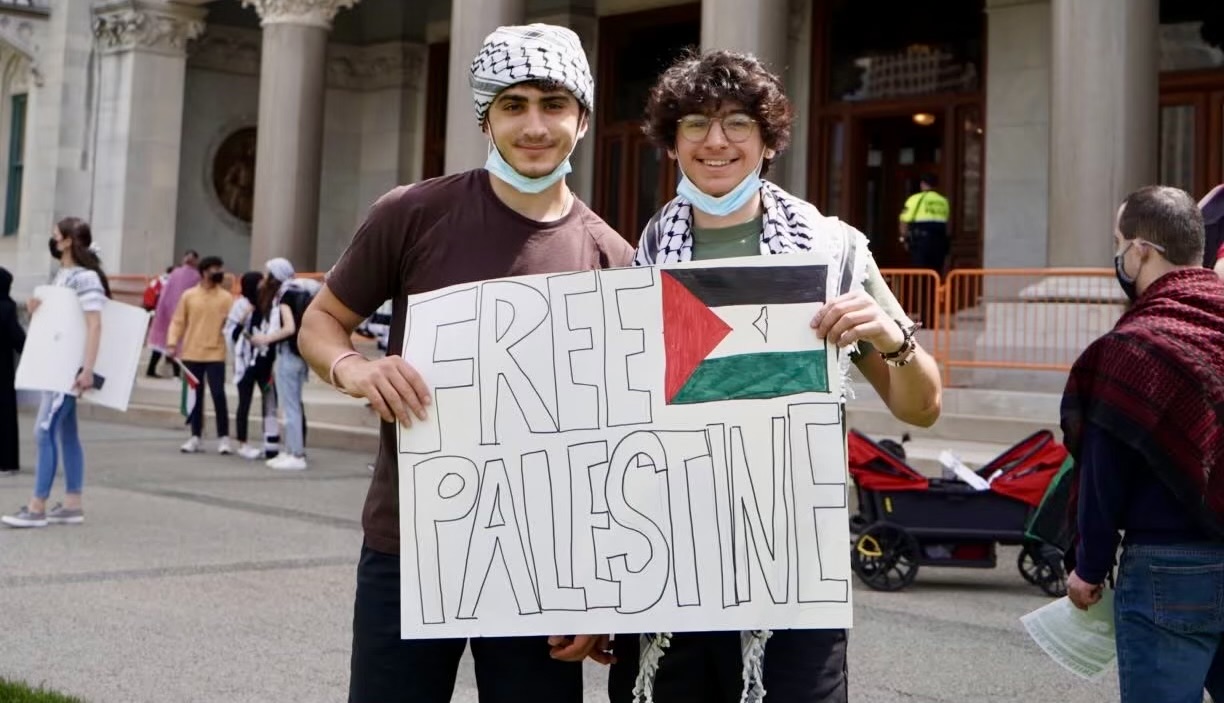
Featured Image: Baha Alsaqri (left), Omar Majdoub (right) in New Haven.
Photos courtesy of Omar Majdoub, Hadeel Majdoub, Menna Majdoub, Mirvat Alsaqri, and Oraib Jasser Alramahi.
Does he still drive while drunk?
This was a great piece. I was fortunate enough to meet and interact with the Majdoub family as my son and Omar have been good friends for years. Very kind, solid and awesome people.
I was specifically moved by the statements about how we have many “experts” related to that area of the world and the struggles the people face. It’s not lost on me the how it’s nearly impossible to pretend to know or understand when we Americans have never had to endure the hardship, displacement and explicit danger that is prevalent in that region. We take peace and freedom for granted, which is very risky.
I hope someday that area can become a beacon of peace and prosperity, touching all who chose to make it their home. There has been too much violence for far too long.
Thank you for a great read.
Amazing writing! Thank you so much for such an insightful post on the lives a Palestinian muslim in America. You write with such eloquence and detail; this is what true investigative journalism looks like!
The writing here really drew me in… It was hard to not tear up when reading some of the testimonies, I could really feel the emotion of the moment in these interviews. Thank you for shining a light on a highly misunderstood subject. Truly outstanding work.
This is great alexis !
This is a great story alexis
Very touching piece, and what an amazing and well spoken writer you are!
Amazing, informative article. Beautifully written!
This is so descriptive, it felt like i was there with you. Amazing article!
What an amazing piece!! Brings so many issues to the surface, but on a personal/family level. Very informative and touching
Incredibly written.Stories like these are important for humanity!
beautiful story
Beautifully written!
Wow, what an amazing piece of writing!
Thanks for sharing this amazing article, it has a lot of the untold stories. I hope you continue writing and educating us about the suffering and justice we wish for this world.
I love this…. So vivid and emotional … Palestine will be free
This is a wonderful article. A Palestinian home is always welcoming.
This is such a powerful article! Thank you for sharing your experiences 🙂
It really felt like you were sitting with the family. Thank you for sharing this beautiful piece
Well articulated article , very descriptive and gives us great insight about the life of a Palestinian family in the US , it made me feel that I know every family member personally ,, well done
Great read, such a captivating article.
Beautiful, insightful writing