

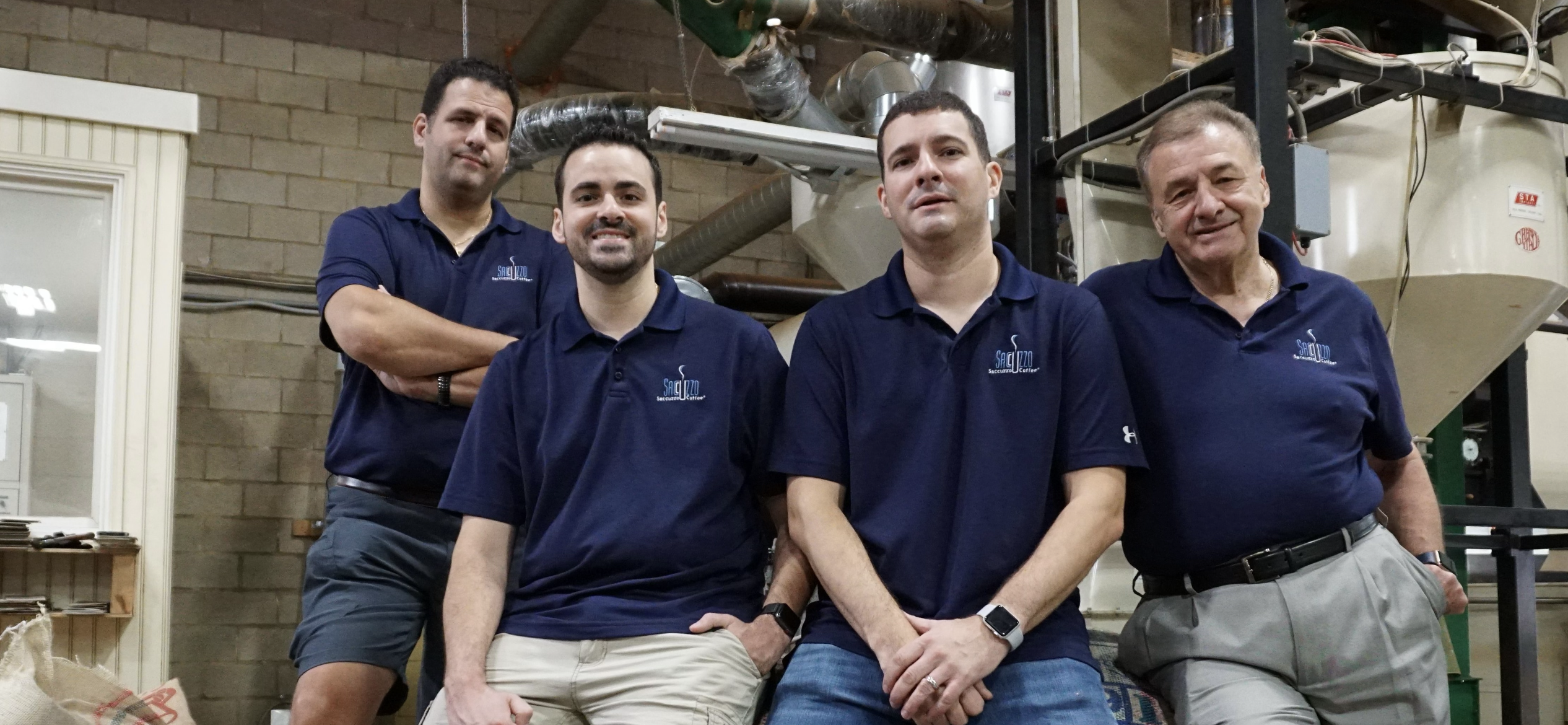
Smoky, aromatic notes of chocolate permeate the parking lot of Saccuzzo Coffee, an Italian family-owned roaster. The Newington-based roaster operates out of a tan brick industrial-style building in a corporate district off the Berlin Turnpike. Geese paddle across a small pond beside the lot, perhaps drawn in by the sweet scent of Saccuzzo’s dutch cocoa.
Inside, Vincenzo Saccuzzo stands behind the long desk in a Saccuzzo-embroidered navy-blue T-shirt and gray khakis. His son Marco is dressed in the same company swag with blue jeans. The family-owned business has been roasting beans for over forty years. Marco greets me beside the front desk. “Deanna, right?” Marco reaches out, prompting a handshake, and we make our way to the four coffee trees that stand tall inside the lobby along floor-to-ceiling windows.

Fashioned in a row of planters, the branches hold clusters of plump and vibrant red cherries that encase the green, raw beans. The trees are primarily for decoration, not consumption. New England, or for that matter, the entire US climate, does not support growing coffee. Marco drops a few cherries into my palm and delicately brushes his hands through the exuberantly ripe leaves. “In Central and South America, around the equator, it’s five years before they start producing fruit,” he says, plucking a cherry from its stem and squishing it between his fingers. The skin peels back, revealing a mushy pulp, similar to that of a plum.
The life cycle of a bean, from hillsides and valley slopes, and into a decorative mug at a restaurant or kitchen in America is an intricate and careful journey. Coffee is the second-most-valuable commodity in the world, following oil, according to the Institute of Food Technologists. A National Coffee Association report from 2022 found that the economic impact of the coffee industry in the United States was over $343 billion, which is a 52 percent increase from 2015. Nearly two-thirds of Americans drink coffee every day. We love our joe.

“We get beans from all over the world,” says Marco, peppering the countertop with plastic bags full of green, raw beans. “These are all from Colombia.” Along with Peru, Indonesia, Brazil, and Nicaragua, Colombia is one of the countries where Saccuzzo sources beans. Before the bean makes its way to Saccuzzo, it undergoes a five-year journey among beds of trees in tropical equatorial countries, between ten degrees north and ten degrees south. The cherry seedlings get planted during the wet season while the soil stays moist and allows the roots to mature. Marco eagerly stretches the bag open and places it under my nose; an unexpected grassy scent flows into the lobby air. The signature toasted-cocoa aroma comes after the roasting process.
The equator is the prime location for coffee trees to thrive due to the constant rainfall, warm climates, rich soils, and the relative lack of pests and diseases. Altitude also affects flavor. In Brazil, the trees reside in lower lands, which produce delicate notes when processed and brewed. In higher altitudes such as mountainsides, the taste is more concentrated, says Marco. He tosses the mushed cherry into a nearby trash can.
Saccuzzo seeks specific criteria and flavor notes within beans depending on which country they are grown in. African beans are primarily acidic and sweet with fruity notes, Brazilian smooth and nutty, Indonesian thick and tobacco-esque, and Central America contains well-rounded, floral notes. “They have some coffees in Brazil that grow lower; they’re softer, less dense coffee,” Marco notes, placing the Colombian samples back into the cabinets.
The most popular bean among America’s taste palate, and worldwide, is the Arabica plant. Starbucks sells 100 percent specialty grade Arabica, and is brewed into americanos, drip coffees, or lattes, whatever the customer fancies.
“We started roasting coffee and building espresso machines in the eighties,” Marco recounts as we pass the antique espresso machines on tabletops. “My dad would import beans from Italy and we would assemble them in a factory in East Hartford.” Marco continues to give me a tour of old machines, each one a time capsule of Vincenzo’s hard work and passion for coffee.
Before the raw beans get polished, they undergo one of three methods of processing: natural, washed, and honey.
The natural process is what it is—natural, Marco explains, tapping the rectangular-frame glasses up his nose. The whole cherries get extracted from the tree, then dry in the sun, yielding a sweet, fruity flavor. “If it’s done properly, it will have almost a raspberry or blueberry taste to it,” Marco explains. As for the washed process, the bean is removed from the cherry, then the slimy layer of organic matter is stripped, setting forth a cleaner taste. The honey process allows for the sticky layer of mucilage to seep into the bean, permitting the sweetest taste.
“This is the factory where we roast all of our coffee,” Marco says as he walks through a set of doors into a cavernous space. A husky cocoa scent swarms my nostrils. A coffee nerd’s heaven on earth. And it’s very loud. Ceiling fans are aerating and Saccuzzo relatives are busily walking about in their navy T-shirts and khakis. Sacks of imported beans are stacked in burlap bags on scattered carts, waiting to be processed into a mug somewhere in North America. Marco begins to talk about the importation of the beans and how many sacks they’ll receive from growers. “We’ll get anywhere from four to five bags,” he says, pointing to a pile of imported beans—Grown by Rwandan Women is etched in thick ink lettering across the brown netting.
“You usually have to let the coffee sit for about two to three days before the customer gets it, or else it will be too sharp.”
The green coffee silo is a machine that transforms the raw bean into the roasted bean, and it is parted into eight cells. It towers overhead, dominating the warehouse. Attached pipes run along the ceiling and omit a persistent hum as the beans travel to the roaster. Marco uses his pointer finger to draw a line along the pipes that connect the silo to the roaster. “In bean form, you wanna let it sit for about a week.” The post roast time frame allows the flavors to morph into their optimal flavor. As the shining silver cooling tray circles the newly roasted java, the smoky, chocolaty aroma from the parking lot fills the factory.
The packaging station sits to the roaster’s right. “This can do eighteen to nineteen bags a minute,” he says as he surveys the machine to ensure the package wrapping is in-line. The two-pound bags are stored on shelves that mount the nearby walls, ready for distribution to Saccuzzo’s loyal customers. “On a weekly basis, we do anywhere from two to five thousand bags of coffee.” Among their signature Grande Italia roasts are their Miscela Bar espresso beans; a Roastmaster blend of dutch cocoa, vanilla, and red berry; and plenty more to explore in the shop. They sell over six different varieties.
“If you don’t have this, the bag will blow up into a football,” he says as he runs his finger over the degassing valve. There are many intricacies that work together in keeping coffee beans at prime freshness.
Saccuzzo samples their blends in a tasting room. “It depends on what coffee it is, where it’s coming from, and how we have to use it,” Marco says, scooping the ground espresso into the portafilter and tamping it down. Brazilian coffee is used in their espresso blends as a base to yield a creamy and thick mouthfeel.

As a grand finale to close off the tour, Marco brews a shot of their signature Grande Italia espresso, to my delight. He navigates the espresso machine with ease and finesses a beautiful golden crema. A Saccuzzo cup and saucer houses the shot, accompanied by a demitasse spoon. The texture is creamy and mouth-coating with a raspberry aftertaste, as Marco promised. And the temperature is just right, brewed between 190 and 196 degrees Fahrenheit. As I sit and sip, Marco provides commentary on the various art pieces that dot the walls; mainly color-coded maps of the equatorial regions and the economic coffee demand each one yields.
Back between the coffee trees in the company lobby, Marco plucks a bag of Grande Italia from the display shelf as if a cherry from its branch, gifting me a bag of Saccuzzo’s finest. The handcrafted blend runs smoother through my Breville machine at home than any mass-produced beans. All I need is a decorative demitasse espresso set to fulfill the Saccuzzo experience. Deliziosa—grazie.
Deanna Prescott is a staff writer for Blue Muse Magazine.
Photos courtesy of Deanna Prescott and Marco Saccuzzo.
Grazie Deanna for this beautifully crafted feature.