

Straddling the painted, three-toed dinosaur prints, my four-year-old niece Scarlett hops from one foot to another, from orange to blue, squawking like a Pterodactyl. Traveling twenty-five-hundred-million years into the past, she prances through a time when the first dinosaurs roamed the Connecticut Valley. Each foot along the ninety-foot-long granite walkway from the parking lot to the large dome museum represents fifty million years of Earth’s history.

Occupying eighty acres in Rocky Hill, Connecticut, the Dinosaur State Park is a beacon for school field trips and dinosaur enthusiasts, making it the perfect place to take Scarlett on a quick day trip. A baby blue dress flares out to her ankles, sprinkled with white flowers. Scarlett is ready to hunt some dinosaurs, sporting her trusty green and purple Birkenstocks paired with her Lilo and Stitch socks. Her blonde hair, wild and untamed, encapsulates her spirit and thirst for knowledge. The geodesic Arboretum looms ahead, protecting hundreds of fossilized tracks. Approximately 55,000 square feet, it holds the promise of being the largest and most extensive collection of Early Jurassic dinosaur track sites in North America.
Fake vines hang from the ceiling, and a teenager greets us with a bored and tired expression from behind the welcome desk. Her blonde hair is slicked back into a bun, and she reads the same rehearsed script she gave to the family before, while smacking her gum. “Six dollars for adults, and kids five and under are free.” After forking up the six dollars, the teen returns to reading her magazine.
Scarlett beelines to the exhibit center without stopping to pick out a dinosaur stuffed animal or a jungle puzzle from the overpriced gift shop: a first time for everything. The lights inside the notable dome are dim, and the smell of cool rock and moist soil fills the air. The exhibits are displayed in a large circle under the dome. A step to our right, various reptiles and insects are stacked one on top of another: Polo, the three-striped mud turtle; Walter, the African bullfrog; Madagascar hissing cockroaches; Waldo, the African spurred tortoise; and Fiona, the boa constrictor. As Polo swims around, trapped inside a tank that’s two sizes too small, Scarlett presses her sticky fingers up against the glass. “Look, Jess, look! A turtle!” She smushes her face as close as possible to the tank, her eyes wide and twinkling for Polo, who has simply traveled from the water to the singular rock to sunbathe. As she passes each animal, she never misses the opportunity to point it out and pose for a picture with a broad smile plastered on her face.
“Theropods are still with us today. Birds are living theropods, so your backyard robin is a feathered, mini-dinosaur. “
Around the next curve, we are met with a life-size Theropod. At forty feet, it towers over Scarlett. Theropoda is one of the three major clades of dinosaurs characterized by hollow bones, three toes, and claws on each limb. Scarlett is drawn to a tablet posted underneath the Theropod to learn more about the Late Triassic period. She bounces from screen-to-screen, each presenting an interactive history game. Her tongue peeks out of her mouth; her fingers splayed out as she peers at the tablet from her tiptoes. Scarlett spends a total of fifteen minutes—a record-breaking time for a preschooler’s attention span—on matching and identifying eight dinosaur prints.

The Earth was more than four billion years old when part of Central Connecticut began sinking along a great fault. For forty million years, geological events have shaped the Connecticut Valley. The first recorded discovery of fossil tracks was found in 1802 in South Hadley, Massachusetts, by Pliny Moody, a schoolboy who came across the artifact while plowing. Nearly forty years later, the name “Dinosaur” (stemming from the Greek words for “monstrous lizard.”) was invented to describe fossil reptiles found in England. The Connecticut Valley has yielded fossils of ancient animals from Massachusetts to the southern coast. Still, many of its former inhabitants remain a mystery.

The discovery room was by far the most intricate display for young learners. Long tables house magnifying glasses, bird cages, crystal rocks, reptile tanks, and bead mazes. Scarlett immediately runs to The Interactive Sandbox with eyebrows furrowed. Kids and adults surrounding the sandbox are mesmerized as they dig up and uncover fossils, build volcanoes, and create lakes. How does it work? The above projector senses changes in the depth of the sand and projects a new landscape when the sand is molded into a new design. Landscapes ranging from a classic Jurassic Park jungle to dry, arid regions with dead animal carcasses made it challenging to pull Scarlett away. As she sweeps through the sand, shapes emerge, and with each discovery brings squeals of excitement, echoed by the few children who can’t be bothered to move on to other exhibits. What felt like play was also a miniature paleontology lesson, though for a four-year-old, it was simply treasure hunting.
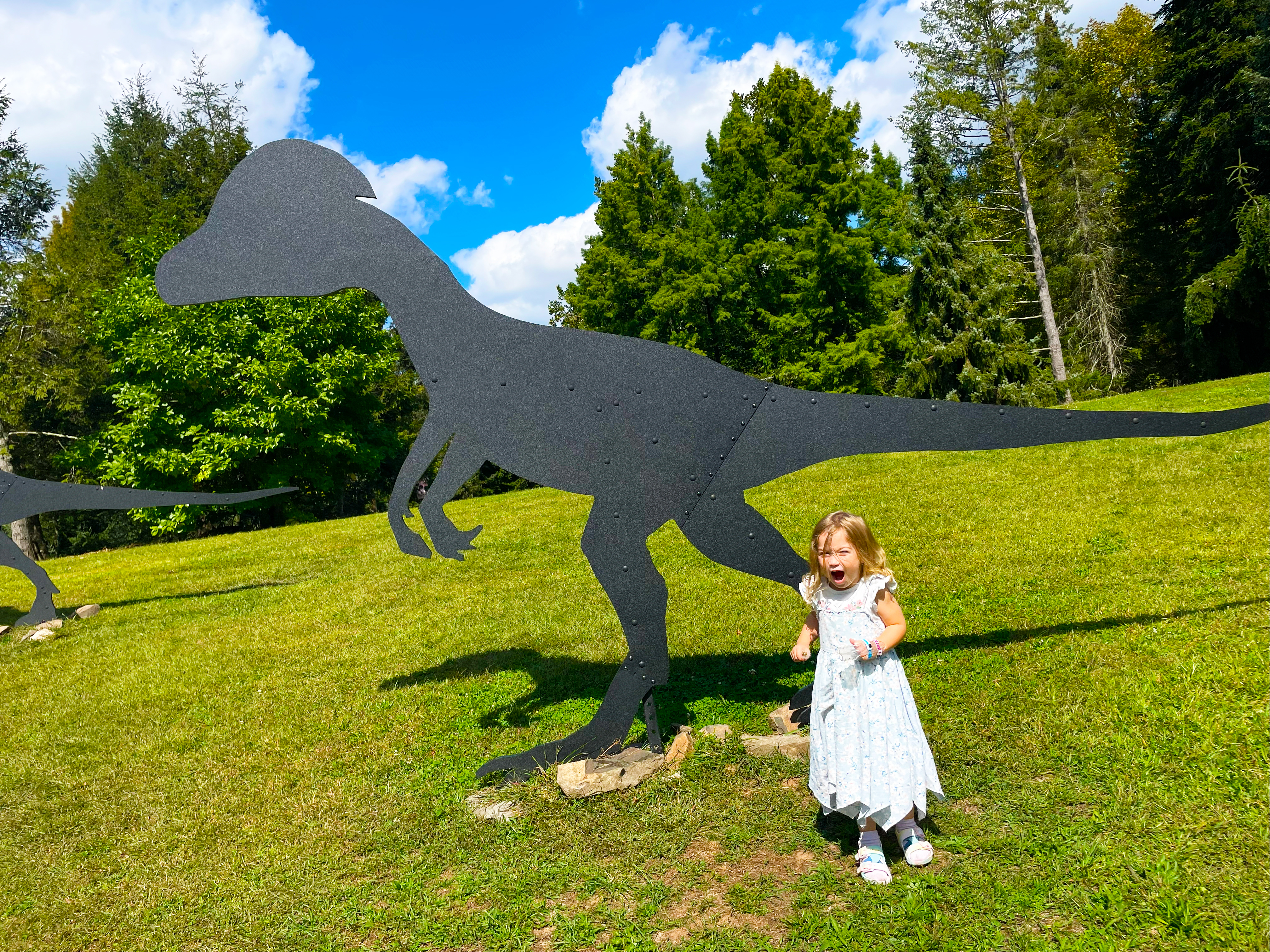
By late afternoon, our legs are weary from standing and walking. We make our way back to the car, but not without one last stop. Outside, beyond the rise of a hill, two towering dinosaur silhouettes stand guard. “Come get me!” Playing tag, our burst of energy lasts us all the way to the large dinosaur cutouts, and Scarlett plants herself for one last picture next to the dinosaurs we’ve found. Sweaty hair sticks to her forehead, and she roars like a dinosaur.

What struck me wasn’t our prehistoric ancestors, but how quickly she turned every small detail into a discovery worth celebrating. The museum was a set of exhibits and facts, but for her, it became a world alive with possibility. In that sense, the day wasn’t really about dinosaurs at all. It was about perspective; seeing through her eyes made me slow down and notice things I would’ve otherwise overlooked. The real value of the Rocky Hill Dinosaur State Park is not just the preservation of history, but giving visitors a chance to remember how to look at the world with wonder.
Featured Image: Scarlett in Front of Dinosaur Silhouette / Photo Credit Jessica Eaton
The unfettered 4 year old niece and the bored teen…all there at the park. Wonderful story! And “roaring” photo of your niece at the top is just great.