

Photos of an abandoned Montana gold rush town from the early 1900s have been collecting dust, forgotten by their photographer. But they are given a second life at Norwich Camera Company. The former ghost town is immortalized in black-and-white print at this local Connecticut company. The longevity and ability to capture moments are part of the reason young people, raised on digital cameras and iPhones, are becoming interested in film.
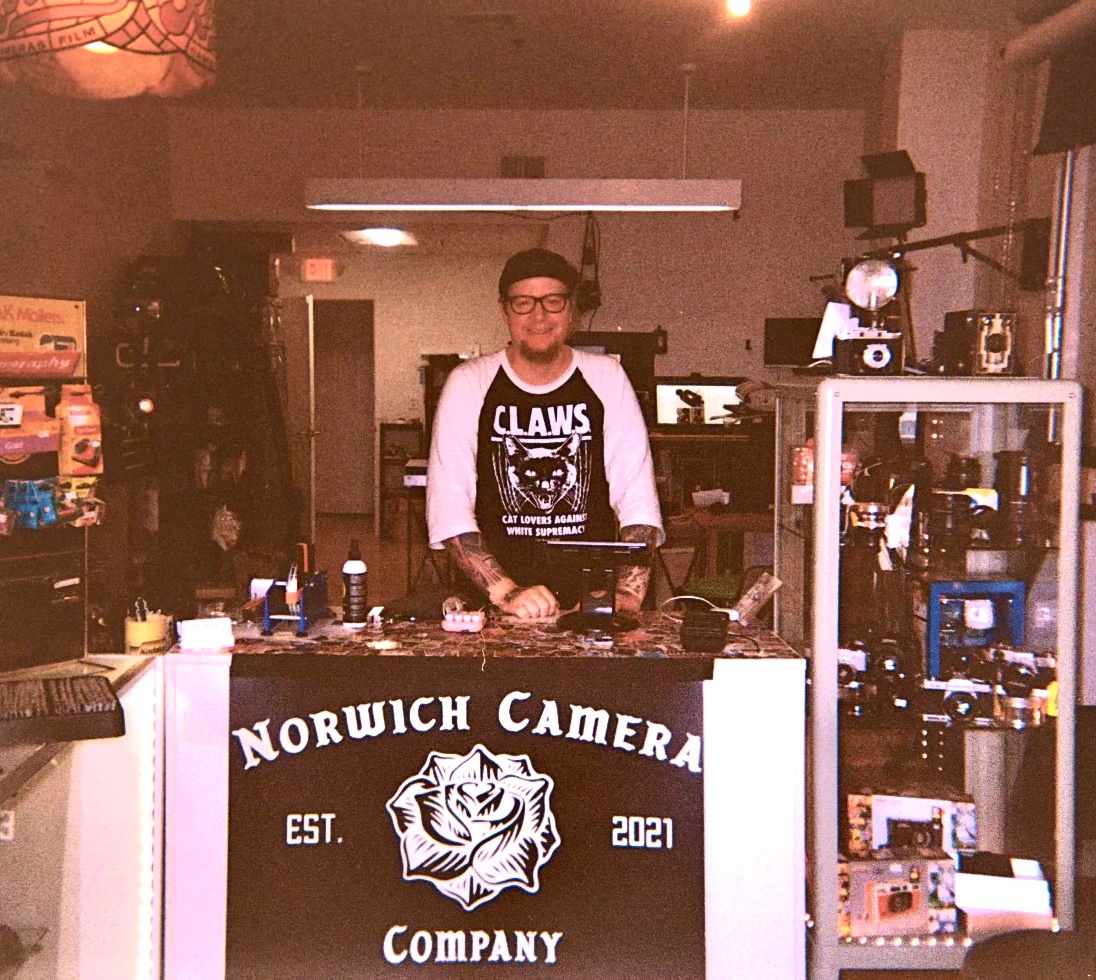
The eccentric camera store, which could be mistaken for a record shop, sits on Franklin Street in Norwich. A skeleton surrounded by camera paraphernalia, welcomes customers, as does the very much alive part-owner, Andy Pigg. A collection of traditional-style tattoos, including a large Darth Vader piece visible under the sleeves of his cat lovers against white supremacy shirt, and two colored portraits on the tops of his hands. He wears a black cap that sits atop his head, above his dark-rimmed glasses. He stands behind a glass case holding a variety of cameras, accessories, and film. There are Nikon, Canon, and indie brands you have never heard of lining the shelves. A wide variety of film options are spread out above the lenses for sale. Hanging on the wall are rows upon rows of film options and even more cameras hang from a refurbished pallet.

They lie in boxes on the floor, or among the many rows of shelving units; some even sit on the desk waiting for repairs. Several are waiting on their shiny new parts to arrive so they can return to their life of snapping pictures. Others live with the impending doom of being broken down for their parts and Frankensteined into a new camera. Few are old, and growing fungus in the shutter; and a handful are unique 3D printed creations, plus, there are simple point-and-shoot cameras waiting for a new owner.
Three friends– Alan Waega, Patrick Hennessy, and Andy Pigg– own and run the place. Pigg had been shooting film and developing his own stuff in 2020 when he met Waega, who was also really into film. Pigg began to archive Waega’s old work. They started shooting together, which is when they brought in Hennessy. He got into film and instantly fell in love with the art style. The friends established an LLC to purchase film in bulk for their own use. What started with developing just their own film and their friends’ film slowly morphed into taking mail orders online during Covid, and now they process 120 rolls weekly.

“This machine is the F235, our thirty-five millimeter scanner. So this thing will do twenty rolls of film an hour,” Pigg tells me, standing at his desk beside the scanner. It runs like Chuck E. Cheese’s Ticket Muncher on overdrive. All sorts of machines and electronics are used to develop, and process film, wet plates, negatives, and any other oddball camera artifacts customers may bring in. Scanning options at the Norwich Camera Company range from a modern DSLR, which will capture and automatically scan photos onto the computer, and the Pakon F235 from 1999, which still requires Windows XP to run. Pigg clarifies as he scans in dry plates of an old church a friend brought in.
A majority of their equipment was purchased before the late 2010s film craze, when it was trending on social media. The film popularity died out with the popularity of digital cameras. Being able to take a picture, see it, and retake it as many times as your SD card will allow was preferred over the limit of twenty-seven or thirty-six picture capacity of film cameras. Pigg explains that Kodak’s biggest year of film sales was 2005, and its smallest was 2006. This was due to the growing popularity of digital cameras. Kodak’s own downfall followed this. Pigg explains that “when the Nikon D1 came out, it was really the first viable digital camera for the professional photojournalist to use, and that killed film. It absolutely tanked it, but Kodak filed for bankruptcy in 2012.” Now, a reinvigorated Kodak and Fujifilm have both increased production by twenty percent and seventeen percent, due to a rise in demand.


Pigg began working as a photographer while in port during his time in the Navy, working on submarine service. He burned out using digital cameras and wanted to start experimenting with other mediums. “I’m the type of person who, if I’m going to do it, I’m going all the way in on it. So, yeah, I went all in.” Pigg had bought a Canon AE Program camera, which led him to purchase a developing tank on Craigslist, an enlarger, and other tools to set up his own film lab. His background in engineering and his Navy job in nuclear operations gave him the skills to fix the equipment they have in the store.
“So the days of the traditional film lab are pretty much gone as far as like, one-hour photo apps,” Pigg explains. “They don’t exist.” The film labs that take your film and turn it into a negative within the hour are gone. Very few exist in the country anymore, let alone in Connecticut. Many people have to turn to their local CVS and Walgreens, which then ship out their film to Dwayne’s Photo processing in Kansas. This is unreliable and takes significantly longer than going to a local place that will get your film back to you in a week.
“When the Nikon D1 came out… that killed film.
Eighty-five to ninety-five percent of their clientele are between the ages of eighteen and twenty-five. It is impossible to deny the resurgence of film photography among Gen Z. There is not one reason why the younger generation ended up taking over their customer base. It makes sense that Gen X or millennials were the guiding force in the film resurgence, as they grew up with film. Pigg says it’s a nostalgia thing for them, but not for Gen Z, as the majority of them would have had digital cameras in their childhood. Pigg has his theory as to why it has become such a hit amongst younger people: “I attribute that to COVID, because they were bored and they wanted something else to do at home.” With this newfound free time, people were honing their hobbies, both old and new, from making sourdough bread to learning how to crochet. At home, film development was an easy hobby to start once you acquired the necessary materials and a dark room. Both shooting and developing film became hobbies people could do alone. Popular shows like Euphoria are being shot on film rather than digitally. Along with celebrities like the Jenner sisters and Taylor Swift who use film cameras to create the aesthetic only film can achieve. This popularized the style with their younger fans.

Customers often come in with dusty plates of glass they dug up in a basement. They know jack diddly about, and ask what’s up with them. At the Norwich Camera Company, they have a flatbed scanner that will scan the plates and then upload them onto their computer in a matter of seconds. It will even autorefine the images. Once they scan all the negatives, they will reverse image search. This process allows them to trace the lineage of who owns the dusty basement and use landscape or period-relevant hints in the image to get a location and time range. The relics from the abandoned ghost town in Montana were once just mysterious sheets of glass, sitting in someone’s home, before one of Pigg’s friends brought them in out of curiosity.
These mystery plates are not the only thing dumped at this camera company. People will bring old cameras, probably from the aforementioned basement, assuming they’ll be bought for a decent chunk of change, but are rarely purchased for more than thirty dollars. The cameras are often not as rare or old as the owner assumed, or they are damaged. However, these cameras will not go to waste. They will be taken apart, and any salvageable pieces will be reused for other damaged cameras. Anything that is repairable will get fixed for a new life, whether that be a customer looking for a new toy or one of the three owners looking to expand their collection.

Middle school style lockers in the back of the shop hold a variety of cameras labeled by their type. There are plastic stackable shelves organized based on brand, and box shelves filled with even more cameras, sandwiched between the other storage spaces. Among these cameras is one of the store’s crown jewels, the Gowlandflex. The camera was created by prolific Playboy photographer Pete Gowland in the 60s to take high-quality, full-body images of the model quickly. Before the creation of this camera, photographers would take a picture of the model’s top half, reload the film, and take pictures of the rest of the model’s body, all while she didn’t move, so the two halves would match. He created only about six hundred in his lifetime. A Gowlandflex now sells for upwards of fifteen thousand dollars. “First time I saw one, I was like, that’s the coolest damn thing I’ve ever seen in life.” Pigg waited five years but managed to snag one for one thousand dollars secondhand.
Amateur photography is cool again. People are as creative as ever, and are coming up with new experimental ways of using film photography. With Rochester Kodak now owning its distribution rights again, and hobbyists purchasing more film, prices are going down. More film purchased means film cameras are in demand, both vintage and new. As far as Andy Pigg is concerned, the current film renaissance has no plans of disappearing, “[It’s] not going anywhere, all the way going up.”
Featured Image: Andy Pigg behind the front desk at The Norwich Camera Company, Courtesy of Kiley Spillane
0 comments on “Behind the Lens: How Film Photography is Making a Comeback with Gen Z | Kiley Spillane”