

The History
In 1954, Vietnam was split into two territories: north and south. Communist control in the north intensified tensions with the south, and in 1959 the north invaded, initiating a war that lasted more than a decade. In order to prevent the spread of Communism, the United States felt it was important to support South Vietnam. Cold warriors in the US government strongly believed in the domino theory. The idea being, if one country fell to Communism, others would follow. Although they were not fully involved in the war at this time, the US aided the south by intelligence gathering, using warships along the North Vietnamese coast. On August 2, 1964, one of those warships, the USS Maddox, was attacked by Northern Vietnamese torpedo boats. Another attack occurred two days later and President Johnson took this opportunity to escalate US military forces. In 1965, there were over 180,000 US troops in Vietnam. Three years later there would be over 500,000. My grandfather was one of them.

Wayne Franklyn was a poor boy from Portland, Maine. Raised in a trailer park with no money and little education, he felt there was only one way to honor his country and get the chance to travel the world: join the military. He went on to serve in the United States Air Force for eight years. During that time he served in the Vietnam War as part of the 46th Communications Squadron. This unit was responsible for maintaining radios, telephones, and other teletype devices.
The atrocities of the Vietnam War are well documented. Facing such horrors, young service members sought comfort. One of the available comforts within this poor country was young women looking to make money. It was not uncommon for relations between the soldiers and Vietnamese women to result in pregnancies. The women would often ask for money to take care of the pregnancy, suggesting that they would use the money to abort the child. However, in reality, these women would send the money to support their families in the war-ravaged country. Once the children were born, they were often brought to orphanages and abandoned. In rare cases, these military relationships resulted in marriage. This is the story of my family.

During his deployment, Wayne met Vo Thi Ngoc Mai, an eighteen-year-old Vietnamese woman. The two began a relationship and fell in love. Wayne even helped Mai, my grandmother, get her younger brothers out of an orphanage. He learned Vietnamese and became fairly fluent. His ability to speak the language contributed to the success of his relationship with Mai. Later, he served as a translator for the military, listening to radio chatter from the North Vietnamese. Eventually, three daughters were born in Vietnam: Lien, Wanda, and Teresa. Wayne and Mai got married in 1970 and returned to the United States as a family of five in 1974.
In the eight years that Wayne served in the air force, the family moved around seven times. After returning to the States, they lived in Iran, Greece, Saudi Arabia, and Italy. Military families form close bonds as they travel the world together. All three girls grew up and started their own families. The Franklyn daughters have remained close into adulthood. Every summer, the sisters have a family reunion along with their husbands and children.

After his air force career, Wayne and Mai settled in Portland, Maine. He continued to work as an electronics technician for airplanes until retiring in 2007. In 2013, Wayne passed away after fighting a battle with leukemia. Seven years after his death, the Franklyn women made a shocking discovery.
Fourth Daughter
Margaret Tran was born in Vietnam in 1974. She was adopted in Saigon by a Vietnamese woman a few hours after being born. In 1985, when Margaret was eleven years old, her adoptive mother applied to a program that brought children of US soldiers to America. This was the first time that Margaret learned that she was adopted. They first moved to Brooklyn, New York, but soon relocated to California. In 2000, Margaret married her husband, Christopher. The two settled down in Maryland and had two children. In 2012, Margaret’s adoptive mother passed away. Although Margaret was very fond of her adoptive mother, calling her very loving and caring, she yearned to know more about her birth family.

“I did three or four different DNA tests, and for twenty years, nothing,” Margaret told me recently. She nearly lost hope and prayed to her mother, “Mom, please help me.” In June 2020, it was as though those prayers were answered: she received a notification from the ancestry service 23andMe alerting her of a first cousin in Maine, Rebecca Franklyn.
After connecting online, Rebecca learned of Margaret’s story and connected the DNA strands—Margaret was Wayne Franklyn’s daughter. Rebecca’s mother, Sandy, called the girls and broke the news to them.
My mother, Wanda, was suspicious at first. “Could she be lying? Could there be a mistake? Our concept of the whole family structure now suddenly had to change.” There was only one way to find out. My Aunt Teresa took a 23andMe test that confirmed Margaret was their half sister. This discovery came with an unfortunate realization. Margaret was born after the youngest sister, Teresa, which meant that Wayne must have had an affair during his relationship with Mai. The three sisters, still slightly skeptical, decided they needed to tell their mother. Wanda told me their thoughts at the time. They’d do “whatever Mom decides. If she says to never talk to this girl then we would honor that wish.” They believed that their mother would protest the relationship, however, they were surprised by her response. “She was actually pretty good and she was like, ‘you know what, it’s not the girl’s fault. She’s looking for her family and you’re her sisters, so you guys need to take care of her, and you need to at least hear what she has to say.’” After getting her blessing, Lien, Wanda, and Teresa pursued a relationship with Margaret.
“Could there be a mistake? Our concept of the whole family structure now suddenly had to change.”

There was a struggle to connect in the beginning, due to the fact that all four sisters lived in different states, and Margaret came from a much different background than the other sisters. Although they were born and raised in Vietnam for the early years of their life, the three sisters’ main memories and upbringing were very Americanized, compared to Margaret, who was raised with Vietnamese customs. They also had to acknowledge that there were already differences in the sisters’ relationship dynamics.
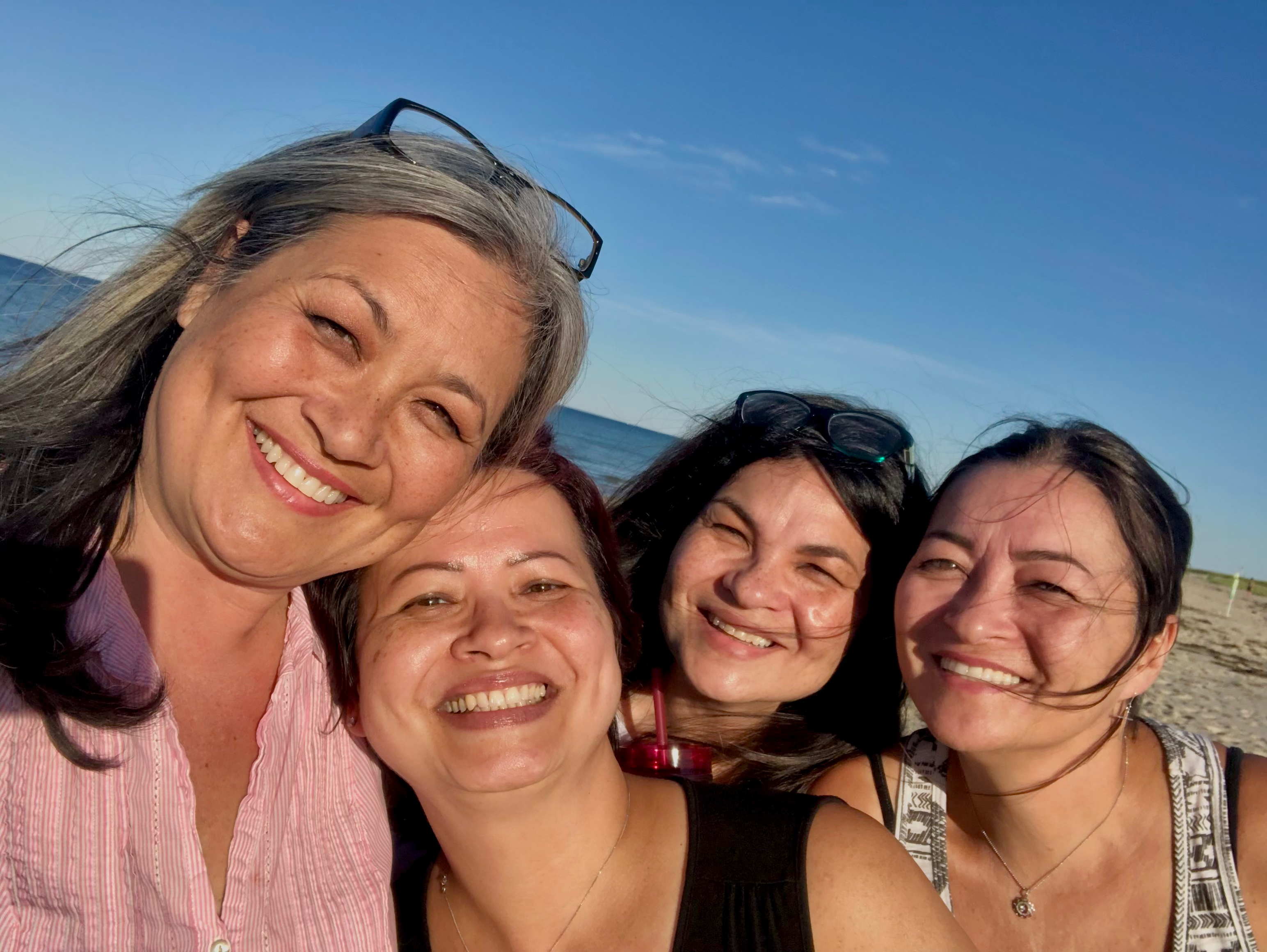
“Trying to integrate her was very difficult because we have fifty years ahead of bonding time,” said Lien. After the pandemic died down, the sisters arranged an in-person meeting. The reunion took place at an Airbnb in Cape Cod. “I felt like that first meeting that we had, we really connected, she was so glad to find us and we were so humbled by the whole experience,” Teresa shared.
It was official. Margaret was part of the family. Although they couldn’t make up for the lost years, the sisters were determined to create their own memories. Margaret’s search was finally over. She told me, “I was screaming out loud to the whole world ‘thank you, universe!’”
What about Dad?
Five years later, I gathered my mother, Wanda, and her sisters, Lien and Teresa, on a group FaceTime to discuss their feelings toward their father. It seemed that the three sisters were in agreement. I’ll let them unpack their complicated feelings.
Teresa: “I was sad more than anything. I was just sad about the whole circumstance. I didn’t hate him, I didn’t blame him. I don’t think there were any winners in that situation.”
“But I was really sad, sad because it happened, and that there was a child left behind.”
Lien: “There were a lot of soldiers who left their children behind in the Vietnam War, and my dad married my mom at the last minute and brought her and her three children to the United States. I feel like he was honorable in doing that. He was also a young kid hanging out with his buddies, and that’s what they did. So I think because I knew that type of stuff, I wasn’t really too harsh on him. But I was really sad, sad because it happened, and that there was a child left behind. Sad that he didn’t know, because he died before we found out about Margaret.”
Wanda: “I hurt for him, and I think that I was probably better equipped than Lien or Terry because my husband, Matt, teaches history, and he did a lot on the Vietnam War and the Civil War. A lot of what we learned in many of the readings is that, one, war is ugly and that it makes people ugly, and two, that there are consequences that are not just from the battlefield.”
Not only did Wanda feel that she had an understanding from learning about the history of the war, but an experience she shared with her father.
Wanda:“There were some things about the Vietnam War that he never talked about that I know haunted him for many years. One year we did a trip to Washington, DC, and we went to see the Vietnam Wall. My dad had wanted to go and begged us to take him with us. And then we got to the Vietnam Wall. He couldn’t get off the bus, and he started to cry. He was on the bus with me. He was kind of frozen. He said, ‘I just can’t, I just can’t.’ So I know that there are things that happened there that still impacted him heavily even after fifty years.”
Ultimately, the Franklyn women feel that their father had a part in bringing the four sisters together after all this time. They can’t change the past, but finally, the four sisters can move forward together.
Featured Image: Wanda, Margaret, Lien, and Teresa at Cape Cod, Courtesy of Jessie Warshauer
What an example of forgiveness and connection. A young man in a war zone that led to some 58,000+ dead from a war that should not have been extended indefinitely – who looked for a way to escape the culture of war and the need for attachment. What is great about this contribution is the role of the mother and the respect her daughters had for their mother and her feelings about her husband’s relations with another. Their welcoming their half-sister in spite of those circumstances is commendable.
Thank you for sharing this incredible family saga and the remarkable comments at the end where everyone processes all of it in the larger context of history and the war itself. Beautiful piece.