

Nestled in the heart of Wallingford, Connecticut, by the intersection of Center and North Orchard Street, is a single glass door cramped tightly between a salon and a cakery. The letters HoG are stamped proudly in blue lettering on the door, accompanied with a graphic of the location’s angry warthog mascot with flaming hair. This is Wallingford’s own Hall of Gaming, a video gaming and social venue specializing in, but not limited to, competitive fighting game tournaments. Here, people from all over the area gather to compete, watch, or simply experience the community created between combatants.

Inside the glass door, an old wooden staircase leads down into a large basement hub. On your way down, various posters and promos from mid-2000s gaming franchises like Zelda, Halo, and other gaming icons, printed on nostalgic plastic-like paper, line the walls. The kind of merchandise you’d find folded neatly in the back of a newly bought Xbox 360 title. At the bottom is a blackboard with an eager “Welcome!” scrawled in its center. Dotted around the Hall of Gaming’s invitation are little notes and messages left between regulars. Within these, players request the “nerfing” and “buffing” of other frequenters of Hall of Gaming, a friendly way of recognizing the strength and competency within the fighting game landscape.
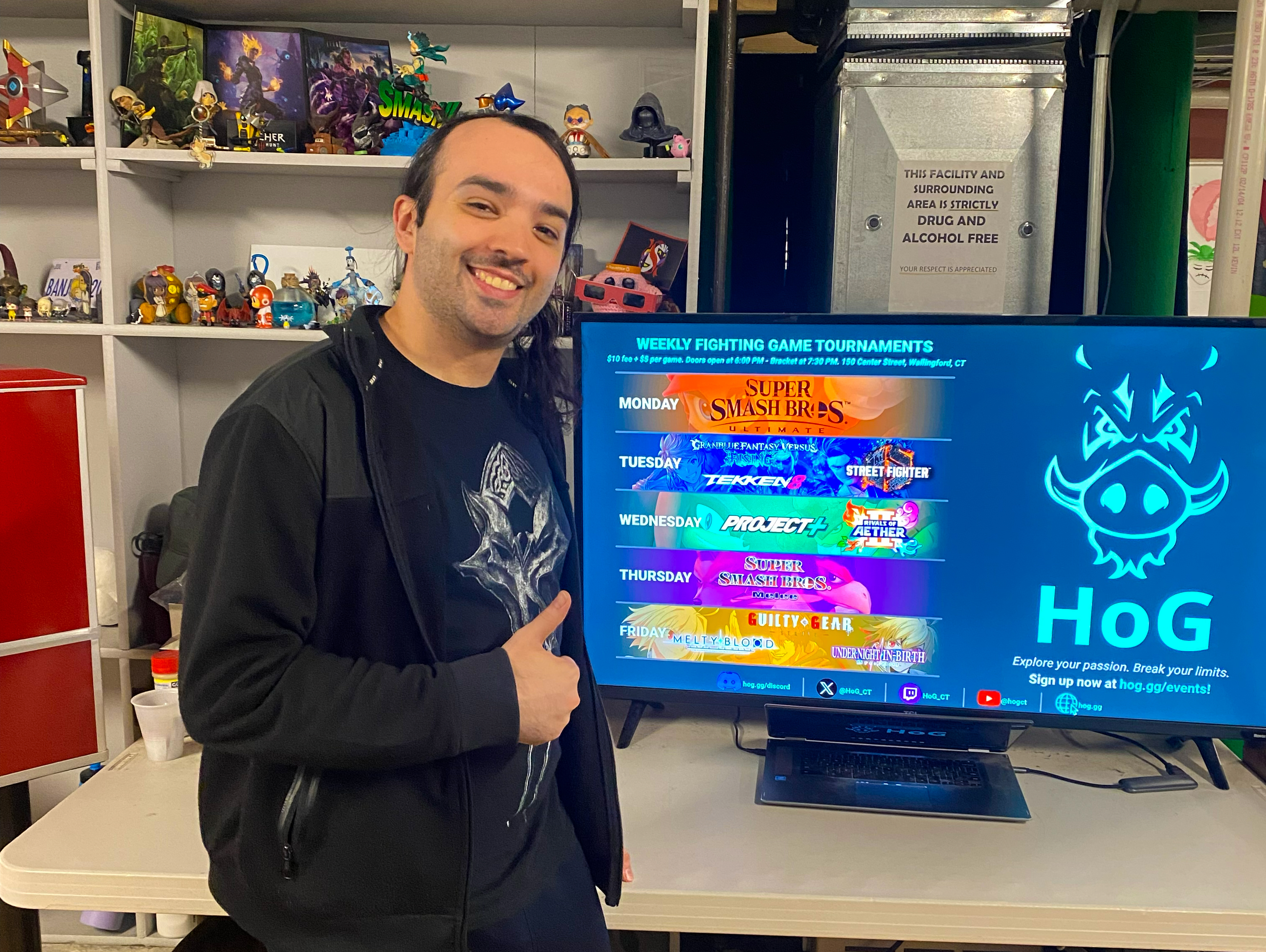
HoG offers players a chance to experience the thrills of real blood sport combat, just without the blood. Much like regulated physical fighting sports, Hall of Gaming offers competitive tournaments that rotate through HoG’s selected fighting game list. Games like Tekken, Street Fighter, and Guilty Gear are just some of the options for fighters to flex their skills. It is simple to enter; the only requirements are a small entry fee of $15, your own personal controller, and the fighting spirit to take home the win. Each day offers new competitive matches with different characters, players, settings, and abilities, and on some days, multiple games may be slotted for tournament play. Just in case you forget, a large flat-screen displays a graphic of the weekly schedule, with the famous HoG mascot on the right. Below the warthog is a call to action for the players.
“Explore your passion. Break your limits.”
Arty Kica, the owner of Hall of Gaming, moves between the players offering advice and handling controllers. It shouldn’t have been a surprise to learn that Arty isn’t hidden in some dank back office, playing the role of disconnected manager, but out in the arena, showing a new player the ropes. Sitting next to the newbie at one of the many CRT TVs, they load into a match of Street Fighter 6. Almost no words were spoken, besides a friendly remark or “that was a good shot.” It would seem, from an outside perspective that these two are simply playing a game, satisfying some entertainment itch in their brain, but Arty knows more. Once the advice was over and Arty had punched, kicked, and pummeled some lessons into his opponent, he had this to say: “He’s basically brand new. He recently moved here, and he was just looking for something to do. He had never played fighting games before. He didn’t really know how it was going to work. He borrows controllers from here. He doesn’t even have his own controller.” Before I can even ask, Arty is proving how integral these spaces are for connection.

Arty spoke with me about his start in fighting games, starting with EVO, an annual tournament held in Nevada for different types of fighting games. Arty, a sophomore in college at the time, heavily connected to Super Smash Bros. Melee, a popular Nintendo fighting game. From here, it was the drive to compete and connect that pushed him to where he is today. It’s no surprise that Arty’s entrance into the Fighting Game Community (FGC) was with his college roommate; these experiences thrive on connection. I asked Arty about the connections he had made. Arty responded: “I made a lot of friends at these tournaments. And at the end of the day, it’s all about the people. If I was playing with robots who had the same exact inputs in the game, I wouldn’t have stuck around. It’s not the same, right?”
Of course, the Hall of Gaming wasn’t always the pillar of the FGC as we know it today. According to Arty, the location was originally owned by “some dad who didn’t play fighting games.” With the previous owner, it was clear the space was not being utilized properly, whether that was the limited game selection, or the lack of interest or knowledge in the genre. Arty was different. “As someone in the community, I had a lot of power to know what it’s like. I know what I want. I know what the people want. I’m friends with everyone here.” Arty decided to approach the previous owner with an offer: to buy this place and remake it into a thriving community. The story doesn’t stop there, “He said, you know what? Instead of giving that money to me, how about you just put that towards the space, and you can have it for free?” Arty goes on to explain that the place was hemorrhaging money at the time, and the previous owner had a family to feed. Once in Arty’s hands, the hall became a pillar of the Wallingford FGC.
HoG starts buzzing at 7:30 p.m. when the tournaments begin. The space immediately has a chaotic charm, with CRT TVs lining the sides of the room and others dotted around where they can fit. Each station holds its own up-to-date console, with bundles of wires and plugs spilling from the back. At the front half of the room are two large flat-screen TVs: one for displaying a schedule of the weekly professional tournaments held, and another for a live screening of matches. To assist in the retro, home-gaming feel, a few sets of comfortable leather couches are set in multiple areas of the room. In the central section of the room sits a large wooden table, joined by an incredible selection of board games for those who may need a break from the digital world.


It wasn’t over yet. Before my friends and I departed, we wanted a taste of what built so many strong relationships here at the Hall of Gaming. After being provided free adapters from Arty to work with the controllers we brought from home, my friends Noah and Ahmed sat at an old TV and booted up our preferred fighting game of choice– Guilty Gear Strive. As my two buddies started a couple of matches, I took in the many groups of friends laughing and competing. It wasn’t long before a stranger wandered toward my friends, closely analyzing the match. Before I knew it, he was fully coaching Noah in a character he had barely any experience with. While I’m not sure whether Noah improved meaningfully from the guy’s coaching, the conversation lit up their faces. Everyone feels like a part of a community at Hall of Gaming. As my friends and I ascended the stairs towards the glass door, I took a look back towards the groups of friends grouped around in wooden chairs. It’s easy to see how this place grabs people and gives them that feeling of belonging we all crave. I can’t wait to come back and pick a good fight.
Featured Image: Arty Kica, the owner of Hall of Gaming / Photo Credit Jake Stanchfield
0 comments on “Virtual Colosseums: The Heart of Wallingford’s FGC | Jake Stanchfield”