

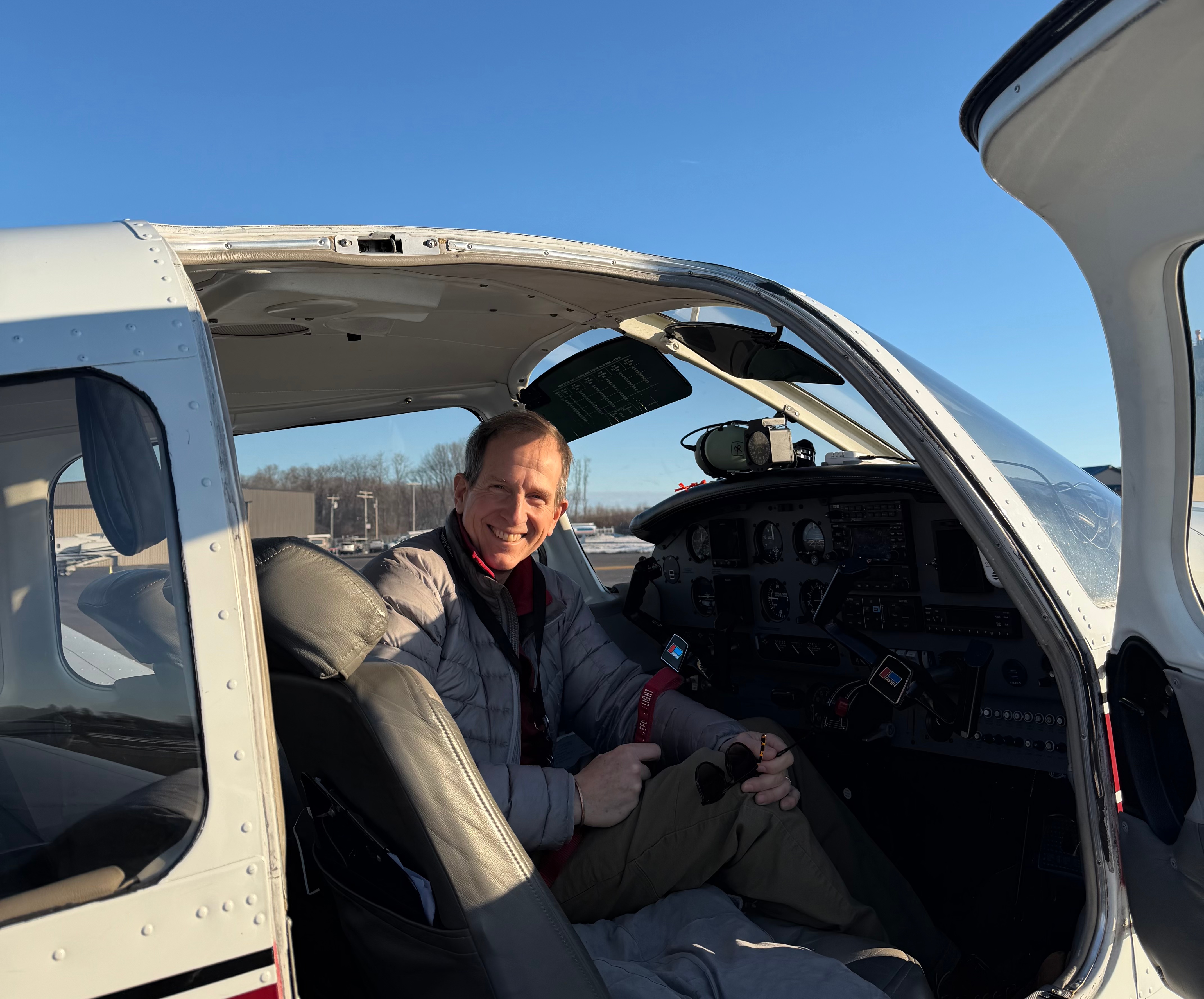
The Piper Archer II banked gently to the right as it climbed above southern Connecticut, its wing cutting through cold winter air. The horizon glowed white where the afternoon sun cut across the windshield. On a clear day, Manhattan would have stood ahead, but the glare swallowed the skyline. Snow-covered neighborhoods stretched beneath the aircraft like a network of intersecting runways and rooftops.
At the controls, Sid Bogardus put on his headset with the practiced rhythm of someone who had logged hundreds of hours in the air. Sid retired as a commercial airline pilot and only recently came out of his hiatus to retrain. Beside him, instructor Laura Baldwin monitored radio channels and scanned the ground below. In the back seat, I worked to stay composed as the aircraft adjusted against the wind, each movement a reminder of how much control depended on laminar current, not certainty.
We leveled out at roughly 3,500 feet. From there, everything felt managed, almost effortless. Reaching that altitude, however, hadn’t been so effortless. It began hours back in New Haven.
Snowflakes scattered across my windshield on my drive to Yale’s Aviation Club. Each flake raised the same question: would the weather cancel the day’s flight as it had the week before? Aviation, after all, answers to avionics, wind, visibility, and caution long before enthusiasm.
Yale’s connection to aviation stretches back more than a century. By 1910, students had already begun organizing around the emerging technology of powered flight. Six years later, a group of undergraduates, led by sophomore F. Trubee Davison, formed what became known as the First Yale Unit.
Their mission was ambitious for the time: to learn to fly aircraft and contribute to the development of military aviation. Because many of the young men came from wealthy families, newspapers of the era dubbed them the “Millionaires’ Unit.”
After receiving authorization from the Navy, the group completed its flight training during the summer of 1916. Thirteen days before the United States entered World War I, all twenty-nine members volunteered for service.
Some of those early aviators died overseas. Others returned to become major figures in American aviation. Lt. David Ingalls became the first naval aviator to achieve ace status and later served as Assistant Secretary of the Navy. Fellow members Robert Lovett and Artemus “Di” Gates went on to hold significant leadership roles in the Army and Navy air corps.
Today, the organization operates . . . open to anyone interested in aviation.
Today, the organization operates as an independent membership flying club, open to anyone interested in aviation and built around access to training, aircraft, and a shared community of flight.
Folded into a residential stretch of New Haven, the runway of Tweed Airport cuts through the neighborhood with little warning. The terminal is modest, almost temporary.
When I texted Laura Baldwin that I could not find the club’s building, she stepped outside to find me. She moved with a kind of immediate awareness, easy and direct. Around her neck hung a silver necklace shaped like a coiled snake, holding a square blue pendant with a small simmering airplane set into its surface. Her Yale Aviation badge rested against a brown sweater and matching pants, practical, coordinated, and unbothered by the cold.
The morning began with a presentation on Civil Air Patrol. Instructor Santos Galatioto, a lieutenant in the program, stood holding a large map and moved through the structure of the organization with steady clarity. He spoke about missions, about roles, and about the coordination required between pilots and observers. Questions came quickly from the room: How many missions? What kind? How many people are involved? The conversation carried a practical curiosity, less about theory and more about doing.
He turned to me, handing me an application. “You’re not a pilot yet, but you can manage communications. Everyone is welcome.”
Among the attendees was Shahara Murphy, a former flight attendant with Avelo Airlines. Murphy now trains to become a pilot while working at Robinson Aviation as a Certified Flight Instructor. An airplane pendant rested at her collar, mimicking Laura’s. She leaned forward throughout the session, her questions precise and focused on hours, certifications, youth training, and common mistakes.

Photo Credit by Nadab Rana
After the presentation, Laura and I sat down in a nearby Robinson Aviation office used by Yale Aviation. She took her time, breaking things down step-by-step. She drew a diagram slowly, making sure I followed before moving on. She explained aerodynamics, how lift works, how balance matters, and how everything in the air comes down to forces working with and against each other.
We went through the weather next. She pulled up reports, explained how to read them, and how to understand wind direction, visibility, cloud ceilings, and icing risks. She showed me where to find everything, how to check it, and how often it updates. The weather was a pattern to read rather than a condition to endure. She spoke in layers, building from the basics outward, and somewhere in the middle of it, she paused.
“In aviation, there is a saying: It’s optional to take off,” she said. “But it is not optional to land. So, we always ask the question. Should we go flying today?”
From there, the conversation deepened. She walked me through the PAVE framework: Pilot, Aircraft, Environment, External Pressures, a structure that turns instinct into assessment. She spoke about the documents a pilot carries, the certifications an aircraft requires, and the inspections that anchor every flight. Acronyms stacked on acronyms, each one a shorthand for safety. She moved through weather reports, decoding METARs and forecasts with a precision that made the sky feel legible. Winds, visibility, cloud ceilings, icing risks, each detail mattered, not in isolation but in combination.
Flying . . . is not about defying gravity. It is about respecting everything that keeps you from falling.
It was not overwhelming in the way I expected. It was grounding. Flying, I realized, is not about defying gravity. It is about respecting everything that keeps you from falling.
Not long after, Sid arrived.
Tall, white-haired, dressed in khakis and a red jacket, he carried an iPad filled with weather data and flight information. As a retired commercial pilot, he moved with ease, but not with carelessness. Laura had told me earlier that part of the goal was to get him back into routine: to remind him that when carrying passengers, the pilot must be in top shape. He stepped into that expectation without resistance.

Photo Credit by Nadab Rana
He reviewed everything we had discussed. The aircraft checklist. The airport layout. The runways. He asked Baldwin about Groton and which runway they would favor in a crosswind, reading the day before stepping into it. Then he turned slightly, showing me the airport diagram, pointing out where information lived, how it was stored, and how often it was repeated.
“Redundancy is a good thing.”
Laura followed with the flight details. The flight rule was VFR. The flight type was general aviation. The wind turbulence was light. Departure was New Haven at 2:30 PM.
“What is the altitude you want to fly at?”
“Let’s do 2,800,” Sid said.
“Oh, come on, you chicken.” Laura joked.
“Okay, okay. Let’s do 3,500.”
When I asked who he flew for before retirement, he smiled and glanced toward Laura. “For my pleasure.”
Outside, the Piper Archer II waited on the tarmac, white body with maroon striping, compact against the snow that lined the runway. Up close, its size forced a recalibration. It did not look like something meant to carry certainty. It looked like something that required trust.

Photo Credit: Nadab Rana
The preflight inspection moved with quiet discipline. Surfaces checked. Fuel measured. Instruments verified. At one point, Sid drew a small sample of fuel into a clear container and lifted it toward the light. If water formed a layer above the aviation fuel, the aircraft would be grounded. The liquid glowed a sharp blue, clean and uninterrupted.
Inside the cabin, space tightened immediately. Knees close. Shoulders angled. The seat felt firm, like built for function rather than comfort. The gauges lined the panel ahead and flickered with small movements, data translating itself into action. Through the window, the runway sat just feet away.
Wind pushed snow across the tarmac in thin, restless lines. From the ground, it felt unlikely that anything this small could move cleanly through it.
The engine resisted at first. Two attempts failed. On the third, after priming, it caught. The aircraft shuddered to life, the vibration moving through the frame and into my chest. The headset settled heavily on my ears, sealing me into a layered world of engine, radio, and breath.
Takeoff came almost unnoticed. The ground simply fell away, and the runway narrowed into a thin, gray strip behind us. Sid’s voice moved through the headset as he communicated with air traffic control, guiding us along the Connecticut shoreline. The plane steadied; the earlier resistance replaced by a controlled hum that filled the cabin without overwhelming it.
At one point, Sid reached to adjust the radio and pressed the wrong button.
“Remember,” Laura corrected, “the big one changes the book. The small one changes pages.”
“Knobology,” Sid replied, laughing.
Below us, New Haven stretched outward, softened into gray and white. Inside, the motion settled into rhythm. The air remained active, but it no longer felt unpredictable. It felt managed, negotiated in real time. The aircraft traveled east toward Groton, passing through controlled airspace. Each transition brought a new voice through the headset, one tower handing off to the next. The landing in Groton came smoothly.
“Not bad,” Laura said into the headset. “Nadab, you can tell him that.”
“Good job, Sid,” I said, leaning forward, then catching myself as Laura reminded me to speak directly into the mic. “Smooth.”
There was a pause, then all three of us laughed.
On the return flight, a seagull cut across our path before veering away at the last second.
“Airport seagull,” Laura mused. “They know when to move.”
By the time we got back, the light had shifted. The sky had started to warm, the color changing as the sun dropped lower. The landing in New Haven was different. The wind was stronger. The plane moved more on the way down. When the wheels hit the runway, it was harder and less controlled than before.
“We can walk away and still use the airplane. That is beyond good.”
When I teased Sid about winds finally catching up to him, Laura laughed and added, “We can walk away and still use the airplane. That is beyond good.”
Sid stayed behind to complete post-flight checks while Laura walked back with me toward the building. Along the way, she spoke about how she started flying.

Photo Credit by Nadab Rana
“I started in 2010. It was a twenty-fifth wedding anniversary gift from my husband. He doesn’t like to fly at all. But he knew I did. And he gave me the discovery flight. That’s all it took.” She shook her head, smiling.
I asked about the necklace. She told me it represented The Ninety-Nines, an international organization of women pilots founded by early aviators, including Amelia Earhart. She had bought it at one of their annual meetings in San Antonio, where she had gone to visit her sister.
I asked if people often showed up the way I had, asking for a flight.
“All the time,” she said. “But mostly someone interested in the club. I love giving discovery flights, though, especially kids.”
She mentioned a program she works with through Avelo Airlines, which brings middle school students from East Haven into aviation career exploration, giving them their first exposure to flying. The training required for a pilot license costs about $15,000. “But not all at once,” she said. “It’s just like going to college.”
It stayed somewhere between motion and stillness, as if my body had not fully caught up with where I was.
We reached the building, but the feeling of the flight had not settled yet. It stayed somewhere between motion and stillness, as if my body had not fully caught up with where I was. Walking away, it was hard not to consider joining, despite the high cost. Somewhere above that, like say 3,500 feet, floated an itch to sit in the cockpit next time.
Feature Image – Sid Bogardus in the Piper Archer II / Photo Credit by Nadab Rana
This is so good! Feeling so inspired!