

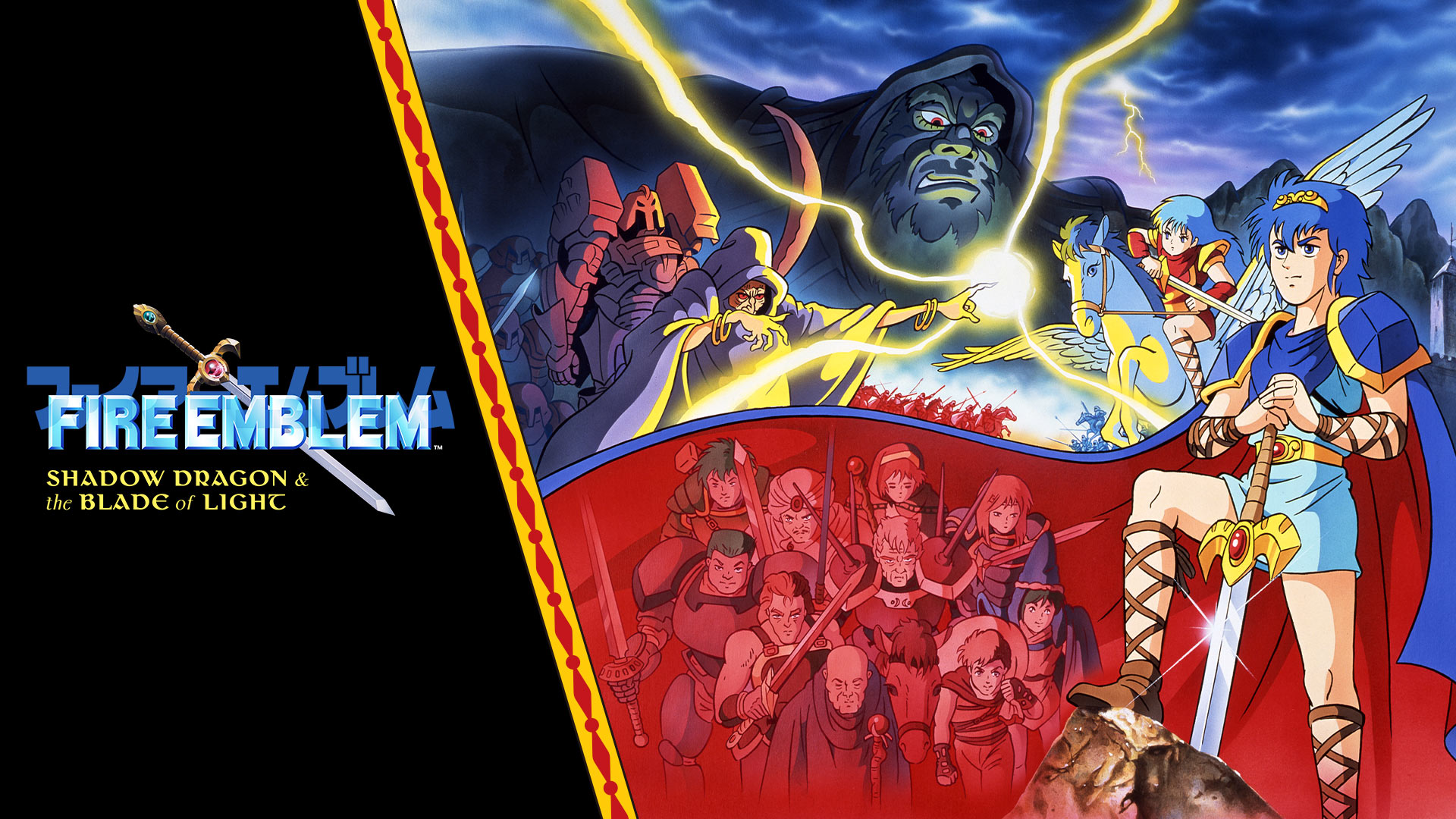
The Fire Emblem franchise, a turn-based fantasy wartime strategy game series, was originally released by Nintendo in 1990. Fire Emblem: Shadow Dragon and the Blade of Light, directed by Keisuke Terasaki, was the start of a decades-long success story in Japan. It took until the 2004 American release of Fire Emblem: The Blazing Blade, the seventh game in the series, for it to go global. Fire Emblem has become more well-known in the United States, but what games tipped the scales, and what made them appeal to gamers?
5. Fire Emblem Echoes: Shadows of Valentia, 2017 – 1 Million units

Shadows of Valentia, released on the Nintendo 3DS, is a remake of the second Fire Emblem game, Gaiden. Shadows of Valentia takes place on the continent of Valentia, where war has broken out between the northern nation of Rigel and the southern nation of Zofia due to their differing deities. The player switches between the two protagonists, Alm and Celica, and their respective bands of fighters, who hope to push back Rigel and reclaim Zofia.
The remake was directed by Toshiyuki Kusakihara, Kenta Nakanishi, and Genki Yokota. It added full voice acting for the first time, as well as new art and designs done by the artist Hidari. It is also the only game in the franchise where using magic attacks takes from the user’s health. It does away with Master Seals, used to promote units from base classes to advanced classes. Instead, promotion is done for free at shrines found around the map. This means you can promote units the second they hit the required levels, without waiting for another item. The remake keeps the original game’s map design and story.
The biggest issue is that Shadows of Valentia is “faithful to a fault.”
It sold around 131,000 copies in Japan its first week, and while there is no concrete number for its global sales, Nintendo considered the game a success during its first year. While it received a warm reception from fans when it initially came out, public opinion has shifted. The biggest issue is that Shadows of Valentia is “faithful to a fault.” Some maps end up feeling gimmicky and tedious, and the narrative falls in on itself by walking back on one of its major themes later in the story, making the social antagonism of the first half feel almost meaningless. Unfortunately, it also retains the misogynistic writing of the time, where the character Faye’s narrative completely revolves around her crush on Alm.
4. Fire Emblem: Engage, 2023 – 1.61 Million units
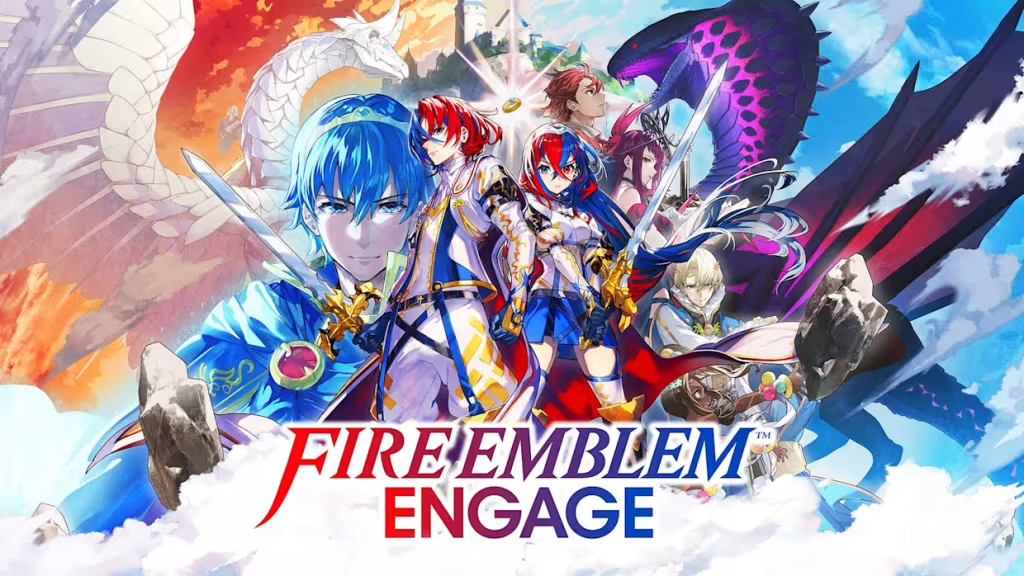
Engage is the most recent Fire Emblem game. A love letter to the series, it involves major characters from the older games within the titular Emblems. Rings characters can wear and fuse with in order to reach more powerful forms, the designs of which can vary from being an interesting reimagining of classic outfits to kinda boring.
Engage keeps the Master Seal formula, as well as a twenty-level cap per class. It also reintroduced the weapons triangle, a gameplay element that had swords do more damage against axes, axes against lances, and lances against swords. With this, they also introduced the break system, where if, for example, an axe character is skewered by a sword, they will be unable to counterattack for the rest of the turn. This works against enemies as well, making it so that the player can ambush tough opponents.
The protagonist is a Divine Dragon named Alear, who has just woken up from a centuries-long coma. After the death of their mother and the theft of her Emblem rings, Alear and various other characters start a journey to reunite all of the Emblems to prevent the revival of the Fell Dragon Sombron. The art was done primarily by Mika Pikazo, and the game was directed by Kenta Nakanishi and Tsutomu Tei. According to Nintendo, Engage sold 430,000 units in Japan and 1,180,000 globally.
Fans think Engage is divisive, with some loving the characters . . .
Fans think Engage is divisive, with some loving the characters and their interactions because of the game’s absurdity, while others feel that their characterization falls flat. Depending on the character, the absurdity can be a bane or a boon. For example, the character Pandreo constantly barks and howls, with some characters embracing it and others being disturbed. But for characters like Yunaka, who at first appears just as zany as the others, is given more depth when she’s taken seriously. The gameplay is fresh and engaging, pun intended, making the combat feel as if it flows faster with more tactical elements.
3. Fire Emblem: Awakening, 2012 – 2.3 Million units

Awakening is seen as the game that saved Fire Emblem, since previous versions sold poorly prior to its 2012 release; Awakening was the last chance for the series. It ended up breaking sales records, in part, because of its Nintendo 3DS bundle.
In Awakening, the player is a tactician with amnesia who is only able to remember their name and battle strategy, an absurd situation even to the characters in the game. This was the first of only two games to introduce the My Unit mechanic, where the player could customize their own unique character. The story focuses on preventing a grim future and the resurrection of a deadly dragon. It was directed by Kouhei Maeda and Genki Yokota, and the art was done primarily by Yusuke Kozaki, some of the best in the franchise.
While Awakening follows the usual Fire Emblem gameplay formula, with Master and Secondary Seals and maxing out at level 20, it did away with the weapons triangle and, most notably, was the first game localized in English to have a casual mode.
Previously, every Fire Emblem game had the gimmick of permadeath, where if your unit died in battle, they were dead for good. In some cases, they would no longer appear in the story. Casual mode was the opposite; death only lasted for that map, and the character would come back in the next chapter.
It was also the second game in Japanese, but the first in English, to have child units. They’re the second generation that were parented by the first, with many of them becoming iconic and beloved characters. Awakening sold 242,000 units within its first week in Japan and 180,000 in its first month in the United States.
. . .it resonated with players so much more than past titles. . .
Awakening’s casual mode and use of the Nintendo 3DS’s powerful hardware at the time are likely the reasons that it resonated with players so much more than past titles. While its characters can feel shallow at first, their clichés make it fun to see how they bounce off of each other and can easily make even the most obscure character someone’s favorite. While the gameplay itself can be incredibly easy, the story and characters more than make up for it.
2. Fire Emblem: Fates, 2015 – 3.1 Million units

Fates was an ambitious project for Intelligent Systems. Directed by Kouhei Maeda and Genki Yokota for the Nintendo 3DS, the game was split into three separate routes: Birthright, Conquest, and Revelations.
The protagonist, a My Unit character like in Awakening, was raised in the kingdom of Nohr but finds out that they were originally a royal of Hoshido, the rival kingdom. In Birthright, the player chooses to side with their Hoshido siblings, with Conquest being the opposite. In Revelations, however, the player chooses not to side with either and instead fights an invisible force pulling the strings.
Fates shares many of its gameplay systems with Awakening, including the inclusion of child units. This was also the first game to include same-sex marriage, but the choices are limited and, unfortunately, come at the expense of their child units. Despite this, the choice to add it in any capacity was progressive for the time, especially for the gaming sphere and a Japanese company.
The iconic ending theme song, “Lost in Thoughts All Alone,” composed by Hiroki Morishita and sung beautifully by the Japanese and English voice actors for Azura, Renka and Rena Strober, quickly became a staple within the community. The lyricism of the song is incredibly poetic, with each of the three verses connecting back to the three routes.
Both Conquest and Birthright carry a heavy theme of sacrifice and grief. . .
Within its first year, Fates sold 780,000 units in Japan and 1.06 million globally. Both Conquest and Birthright carry a heavy theme of sacrifice and grief, especially the mourning of one who still lives, making them both intriguing narratives on their own, but when played in succession, they can lose the emotional effect. Revelations, while being the ‘very happy, everybody lives’ route, derives most of its emotional beats from the feelings of unity and grief for the long-dead. Revelations’ best aspect is the ability to have all your favorite child units in one army.
1. Fire Emblem: Three Houses, 2019 – 4.1 Million units

Three Houses, the first Fire Emblem game to have a simultaneous global release, followed Fates in having more than one route, this time having four.
Developed by Toshiyuki Kusakihara, the protagonist is a young mercenary who works with their father, Jeralt. After protecting the lives of three students, the protagonist is roped into becoming a professor in the Officers Academy at Garreg Mach Monastery. These three students were the heads of the academy’s houses: Dimitri, Claude, and Edelgard. The routes depend on whichever house the player chooses to instruct.
Three Houses does away with the standard Master Seal formula and instead allows the player to change a character’s class almost freely, so long as they meet class criteria, without the loss of any levels. This allows players to mess around with different classes more easily. The player can also recruit other characters from other houses, except for a select few. Being the second game to feature same-sex marriage, it also included more than just one option for the girls, though the men weren’t as lucky, being given only one same-sex pairing.
Three Houses was the first game to be entirely 3D and includes a Divine Pulse mechanic, allowing the player to reverse a couple of turns a set amount of times, making the gameplay easier, but also better retaining the sanity of players. In the past, players would have to redo the whole map if they made a mistake, especially if playing classic mode. This addition gets rid of that need, if only for a while.
The game’s ending theme, which plays during the credits of all routes except one, “Edge of Dawn,” written by Toshiyuki Kusakihara and composed by Takeru Kanazaki, and performed by Caro in Japanese and Buttercup in English, quickly rose to rival Fates’ “Lost in Thoughts All Alone” as the most popular Fire Emblem song. My personal favorite, as it focuses on the perspective of an isolated Edelgard as she navigates her time in school while also chasing after an ambition she knows will destroy her bonds.
The storyline is a sprawling critique of racism, xenophobia, classism, sexism, and religion . . .
Three Houses sold 580,000 units within its first year in Japan and 2,290,000 globally. It’s no surprise it won the Players’ Voice award in the 2019 Game Awards with 45% of the votes. Three Houses is the number one Fire Emblem game, not just because it sold the most, but because it has the most compelling narrative yet. The storyline is a sprawling critique of racism, xenophobia, classism, sexism, and religion, and these themes are strong across most of the routes. Some routes feel like you’re fighting for the status quo, which, when you’ve seen the many injustices of the current system, feels very unfulfilling. The character writing immediately sucks you in, introducing characters with basic RPG cliches and throwing the rug out from under you later. Not Sylvain, though, he’s exactly the kind of person you think he is.
Feature Image: Shadow Dragon and the Blade of Light cover art / Photo Credit: Nintendo and Intelligent Systems
Image 1: Echoes: Shadows of Valentia cover art / Photo Credit: Nintendo and Intelligent Systems
Image 2: Engage cover art / Photo Credit: Nintendo and Intelligent Systems
Image 3: Awakening cover art / Photo Credit: Nintendo and Intelligent Systems
Image 4: Fates full cover art textless / Photo Credit: Fates art book, Nintendo, and Intelligent Systems
Image 5: Three Houses Single Album cover / Photo Credit: Caro, Buttercup, Nintendo, and Intelligent Systems
0 comments on “Top 5 Fire Emblem Games | Cassandra Carey”