

On a recent Sunday morning in a sleepy office park in Branford, Connecticut, one building vibrates with music. The slow, deep beats of Rihanna’s “Sex With Me” can be heard reverberating through white cinder block walls. The sound and dim red light seen peeking through half-blinded windows make it seem like a night club. The parking lot is empty of cars for neighboring businesses—Merry Maids and Directline Media—but full in front of Apex Pole Fitness.

Inside the small studio, LED lights line the floor, casting the entire space in a calming, cycling rainbow light. Five fixed poles are spaced around the room. The back three poles are industry standard, 45 millimeters in diameter, and the front two smaller, 40 millimeter poles. A small class of seven women take a water break and set up their phones to record themselves for the final run-through. They separate themselves into groups to practice what they have learned. Some wear pleasers, while others go barefoot. Everyone is dressed to their own degree of comfort and exposure. One young woman in a tight black shirt and spandex shorts walks slowly around the pole, each step sure and strong in her seven inch snakeskin pleaser boots. She circles, checking the angle of her phone camera on the side of the studio.
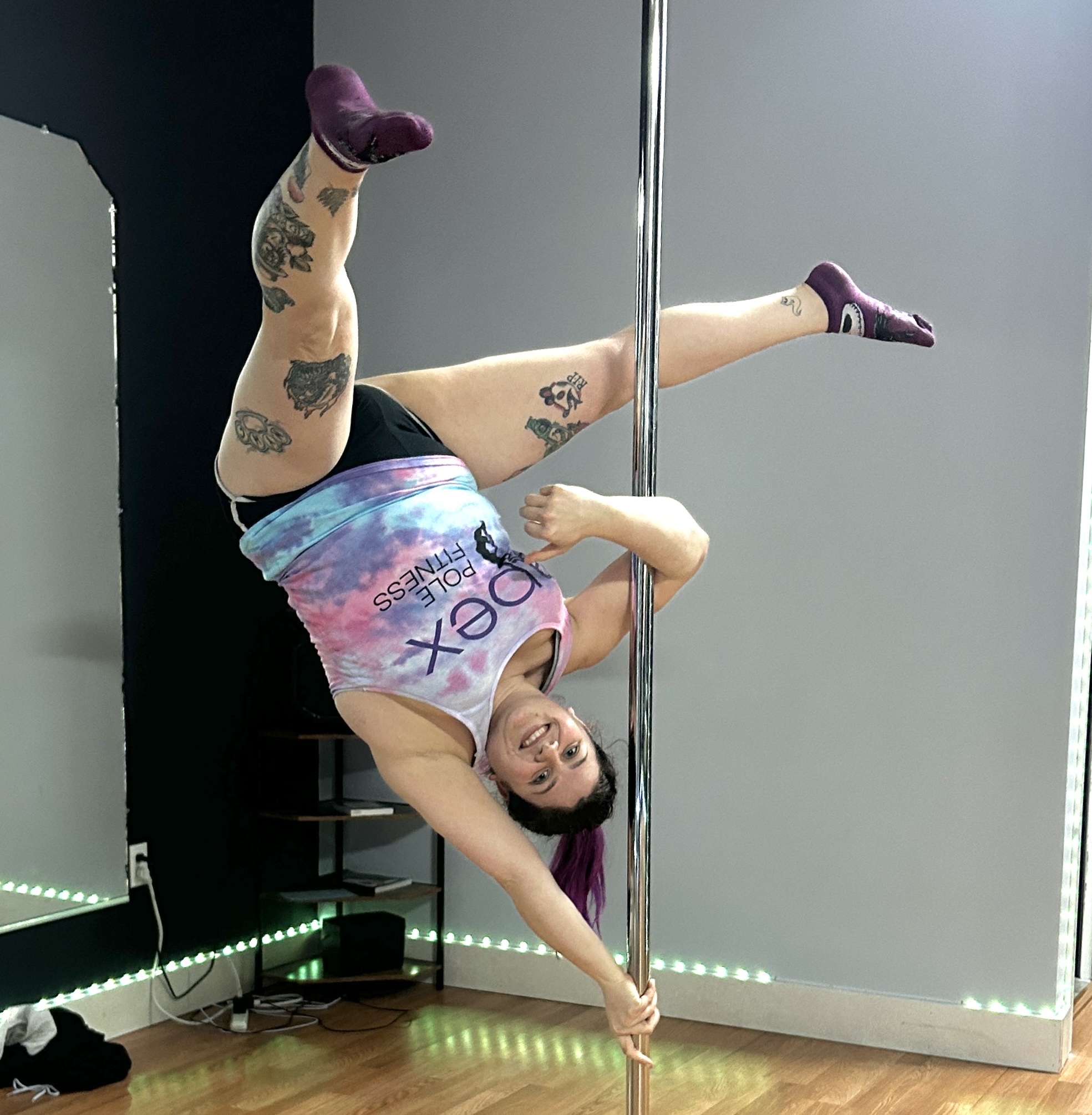
“I need a pair like those for my next competition.” The group’s instructor and studio owner, Jennifer Fabozzi, gushes in between songs. She sits on her knees, her bare legs a patchwork of american traditional style tattoos. Her hair, dip-dyed a bright magenta, is tied up in a bun as she catches her breath from teaching. On her tie-died tank top, the words APEX brand the center in large, bold lettering.

“Pretend like a man just told you to smile more, and you are kicking him in the face!” Fabozzi, known as J Fab, calls out to the dancers as they do a step around spin. She provides some structure for those who want, and need it, before yelling the next move in the combination. All dancers are at varying levels of experience and age, and yet no one seems to worry about what others are thinking. Rolling and doing leg work on the floor, or hanging upside-down inches from the ceiling, every student does their own thing. Moving at their own pace, all of the dancers seem to lose themselves in the slow, sensual music.
A friend tricked J Fab into attending a pole class in 2012; she had no prior dance experience. “I was like, you’re crazy. Like, I’m not graceful and not flexible. I’m not athletic. I don’t know why you think I could do this.” Despite her initial hesitation, she’s been pole dancing for over a decade. She now competes, and has won medals in various pole sports competitions in the North East.
When J Fab began pole dancing, there was still a taboo surrounding the art. “There were two studios in the state, and it was very much, like, a hidden thing.” Dancers were stereotyped as “this dirty woman type of thing.” This perception has shifted over the past decade as the sport became more mainstream. There are now more than a dozen pole studios within the state. “There’s still a negative stigma around it unfortunately, but it’s at least moving in a more positive direction, and it’s giving voices to sex workers, and, you know, giving credit where credit’s due.”
Modern pole dancing can be traced back to the scandalous Hoochie Coochie shows first made popular in the Victorian era. Alternatively called “exotic dance” or “oriental dance,” travelling “little Egypt” circuses first appeared in 1893 at the World Columbian Exposition in Chicago. The American public was both outraged and entranced by the Middle Eastern themed showcase. While the circus was censored by the government for its provocative representation of women, more progressive ideas of sexuality and expression were adopted by performers throughout the twentieth century. During Prohibition, speakeasies and underground clubs often featured female vaudeville and burlesque entertainment. In this era, striptease and circus tricks like aerial arts were often performed, leading to the popularization of gentlemen’s clubs. These acrobatic and teasing performances combined to create our modern concept of pole dancing. The first recorded pole dancing clubs and performances began in the late 1960s in Oregon. It was only in the early twenty-first century that pole dancing became more normalized as a source of fitness and empowerment. Today, pole gyms offer a variety of classes for different levels of experience targeting specific pole skills. Apex’s classes include spins and flows, sits and climbs, partner pole, tiktok troupe, and more.
J Fab opened Apex Pole Fitness in 2014 in collaboration with her friend and first pole instructor, Nicole Motzer. Motzer helped and encouraged her to continue pole dancing. “I had taken classes with other instructors, and she was just my favorite. At that time, I couldn’t even do a push-up,” J Fab explains, sitting on a bench on the edge of the studio, her legs crossed, Nightmare Before Christmas ankle socks on display. Now she looks like she could do one hundred push-ups. “One of the instructors, the owner of that studio, had no idea how to modify it for me to make it accessible.” Behind her, students wipe down their poles or continue to practice tricks like the baby valentine. “She [Nicole] was like, ‘Hey, I did some research, and I found these modifications, and I think this would work for you,’ and she worked with me, and met me where I was at and made things attainable, and she didn’t put her nose up to me.”
“We’re very, very supportive . . . all are welcome.”
J Fab prioritizes inclusion at the Apex. “We’re very, very supportive. I get people all the time that are like, ‘I’m not strong enough, I’m not flexible enough, I don’t look a certain way, I’m not graceful.’ I’m not this, not whatever. But all are welcome.”
After class, Hanna Avery practices her routine for an upcoming competition, spinning slowly near the ceiling. In an emerald green two-piece outfit, holding herself easily upside down, she throws herself into tricks with ease. Her black lab service dog, Aster, yawns rather unamused on her bed by the speaker as she rehearses. She sits halfway up the pole, as she waits for J Fab to hand her grip glue for the pit of her elbow. “We use a lot of pole grip here,” says J Fab, rummaging through a drawer full of sticky adhesives for the bright green squeeze bottle of Monkey Hands. She hands it to her friend seven feet in the air, who applies it to the pit of her elbow, taking her time to prepare herself to do a final runthrough of her three-minute show.

Avery sustained a spinal cord injury in a car accident six years ago, which left her partially paralyzed. She is preparing a routine about the accident for the Memorial Pole Championship in Columbus, Ohio. She has been pole dancing for two years, and began competing after only six months of practicing pole.
Avery tells J Fab to coach her through the routine and yell out to give the right facial expressions. She takes her prop and tucks it into the waistband of her highwaisted pole shorts before climbing all the way to the top of the pole. She wraps her knees around it and sits down like she was in a chair halfway up, lowering her head as the sounds of an engine begin to rumble through the speakers. The radio switches through stations as she removes her phone from her waistband, holding it out in front of her. Avery drops down the length of the pole abruptly, simulating the impact of the car crash. She just hangs there, barely a foot from the floor.
The somber sounds of Radiohead’s “How to Disappear Completely,” fill the post-crash silence. She slowly sinks down, hovering a few inches from the floor as if levitating. Avery makes her way to another pole, throwing out trick after trick as the music crescendos. Gradually she rises back to the top, hooking one leg on the pole and holding herself upside down, and the other outstretched, straight as a needle.

“I used to dance. But when I was in college, I was in an accident, and I never went back. Actually, this routine is about that story. I had to go through spine rehab, I had to relearn how to walk. So I never thought I’d get back to dance. I never thought I’d get back into doing stuff like this.” Avery met J Fab early on in her pole journey, discovering her TikTok in her search for a studio. She took a class and found her pole home. “They haven’t gotten rid of me since. They’re stuck with me now.” Avery looks at J Fab who laughs and smiles. Though she resides in upstate New York, she frequents Apex Pole Fitness. “These are some of the best people in my life. Some of my best friends. That is because the community’s been incredible and incredibly supportive.” These close-knit relationships and support have contributed to the massive growth in people practicing pole, as well as its progress towards recognition as a sport.
Pole competitions have seen massive growth since their introduction in the early 2000s. There are competitions in the states and internationally. Rapid growth in attendance led to the development of an official international scoring system in 2008. Pole organizations and nonprofits pushed to recognize pole sports formally as a sport across the world. One of the most notable, the United States Pole Sports Federation, has done major work to get accreditation and membership from the United States Sports Council.
“Getting pole out there is very important, and really legitimizing it for the athletic endeavor that it truly is. I mean, anyone who does pole knows that it is hard. It’s very hard.” Sarah Samuelson, also known as Gogo, the Pole Athletics Chair, explained in a recent phone interview from her home in Georgia. After getting pole recognized as a sport by the Sports Council, USPSF broadened their goal to an international stage. “We have our eyes, our sites, set on the Olympics, and it’s a big, beautiful, wonderful goal, but there’s a lot of work to do.”
A former USPSF competitor and pole studio owner, Gogo has been advocating for the pole community for over a decade. She has witnessed the broadening of acceptance propelled by social media in recent years. “What I do see is a lot of evolution as it becomes more and more popular in the mainstream.”
Pole has come a long way from its origins in seedy clubs. While still an outlet of sexuality and expression, it has become recognized as something much more complex than a form of entertainment. Gogo expects to see the sport continue to grow in popularity. “Each new person who comes into the pole world kind of shares their stamp with us and it continues to evolve.”
“Each new person who comes into the pole world kind of shares their stamp with us and it continues to evolve.”
Back at Apex, Avery finishes her routine, laying on the ground exhausted beneath the second pole. Smiling, she struggles to catch her breath after the intense performance. The Memorial Pole Championship is just days away. She still questions her facial expressions, discussing with J Fab the elements which she might change to improve. Despite her obsessions over perfection, J Fab knows Avery is more than ready.
Avery gets up, walking towards her tail-wagging pole pup. She takes a long sip of water. “To me, it’s not so much about medaling. It’s more or less about going and getting to showcase my art. It is so fun when everyone is rooting for you.”
Featured Image: Jennifer Fabozzi in the Studio / Photo Credits: Jennifer Fabozzi
Great work, beautifully written!