

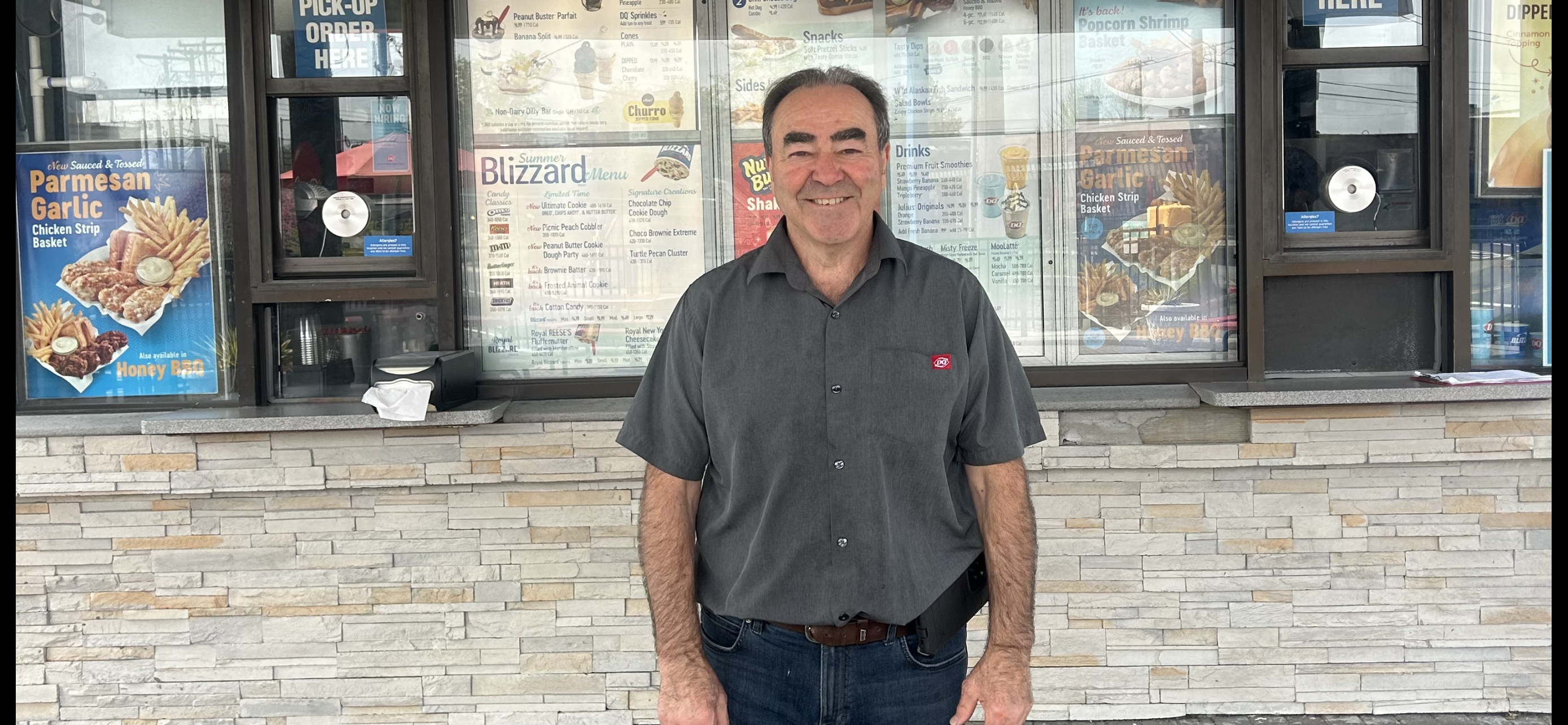
Local businessman Mike Cassetta jumps out of his ginormous black Chevy truck and makes his way into the Kensington, Connecticut Dairy Queen. He wears a gray DQ-embroidered button-down shirt and blue jeans with his phone strapped to a hoister on his belt.
In the middle of the choreographed madness behind the counter, Cassetta, 68, weaves his way through the sea of black polo DQ-embroidered T-shirts, dark blue jeans and red/black visors. He’s a micromanager of his mostly college-age employees. The smell of chicken and vanilla waft through the air, the obnoxious beep of the drive-through is heard through the whole store. His eyes enlarge as he watches a young woman drop a sleeve of small Blizzard cups on the ground, “Five cents! Ten cents! Twenty cents!” he yells. To his employees, dropping a few cups may seem like a simple mistake, but to Cassetta, after spending seventy-six dollars to buy a box of 250 cups, accidents impact the bottom line.
“I don’t yell to be mean, I yell because this is my business.” Cassetta tells the group as he leans his body against the short, white freezer.
“That box of chicken used to be thirty dollars, it’s now seventy.”

For the past twenty years, Mike has grown his business with Dairy Queen from one franchise to five. Over that time, prices have doubled. “It makes me feel lousy because everything else goes up- the labor goes up, price of goods goes up, the stores have to raise prices in order to stay in business. Otherwise we’re going to be closed,” Mike explains. Turning his head towards the kitchen, he watches the cook load the box into the freezer. “That box of chicken used to be thirty dollars, it’s now seventy.” The increased costs are passed on to customers.
Along with the increased cost of cups, chicken, and milk, he also has to watch the jump in minimum wage. Currently, Cassetta’s five stores employ about 155 workers. When he first started out, in 2004, minimum wage in Connecticut was seven dollars and ten cents per hour. In 2024, minimum wage in Connecticut is fifteen dollars and sixty-nine cents per hour. At the corporate level, DQ CEO Troy Bader told CNBC that they’ve seen an eleven percent increase in the last two years due to inflation. From March 2023 to 2024, the Consumer Price Index (CPI) for food away from home, or menu prices, increased four percent. A decrease from previous years, but still higher than consumers want to spend. Consumers are starting to rally against fast food establishments, complaining on social media that cheap food is not so cheap anymore. Without the customers, there is no business, and Cassetta worries that inflation could force him to shut one of his franchises. The higher cost of goods has impacted his bottom line.
Cassetta takes a lot of pride in the DQ brand. As the motto for the franchise stands for PRIDE (Personal Responsibility in Delivering Excellence) he makes sure all of his stores are up to the DQ standard, keeping them clean and safe for the consumers.
“Their rules and regulations are pretty easy, compared to McDonalds and all other ones,” Cassetta says. After hearing his employees complain about closing at ten instead of nine-thirty, he says, “they could pull your franchise if we didn’t close when they wanted us to, they would do that because you’re not doing what they’re telling you to do. It’s a twelve hour day, I don’t make the rules.” DQ corporate mandates stores need to be open twelve hours each day, ten months out of the year.
The next night at closing, Cassetta makes his way through the doors and heads straight over to the drive-through corner. He stares at the leaking soda machine that refuses to produce carbonation. One hand rests on his chin, as the other rests on his hip, examining the machine. “Did they come tonight?” Cassetta asks, frustrated that the machine has broken down multiple times and no one can seem to figure out the problem. The employees shake their heads. Cassetta bows his head in aggravation. “I don’t think people care about doing their jobs anymore,” Cassetta says. He adds, “It makes me feel lousy.”

He moves to the other side of the store, and with his hands on his hips, watches everyone intently. His body leans against the short white freezer, his signature spot. His head shifts from one side of the store to another until something catches his attention. He squints his eyes, putting all of his focus on the drive-through corner. He notices an interaction with a customer that does not seem pleasant. The window shuts, and the angry customer zooms off in their car. “What happened there?” Cassetta asks. The young woman with curly blonde hair working the window adjusts her black visor and turns to Cassetta. She says, “They complained about the price of the cone.” She adds, throwing her fingers into air quotes, “Three dollars and seventy-five cents is ridiculous and she is never coming back.”
“The prices are fair based on what we gotta pay. I don’t raise prices for fun.”
Throwing his hands in the air, Cassetta screams, “Good, they can go somewhere else. If they don’t think that’s fair, I don’t need their business.” His little rant continues. “We have to pay higher wages, higher cost of goods, higher utilities, higher everything, so the prices are fair based on what we gotta pay. I don’t raise prices for fun.”
Cassetta’s five stores are co-managed with his two sons, Paul and Joe. They all laugh at customers who complain about prices. Do they want to raise it? No. Do they need to do it for their business to survive? Yes. The complaints may get annoying but in the end it’s a part of the job, and if they want to keep their business alive they know they have to deal with whatever challenges arise.
“When I retire one day, I feel very confident my sons will be able to take over for me,” Cassetta says. “I’ve trained them to make sure they’re doing the same thing that I do. Like what needs to be done, how to do it. What it means to run a business properly.”

“Being an owner of a fast-food establishment isn’t as easy as it seems,” he jokes. He watches his employees race around filling orders. “It’s the customers and employees that make it hard.”
Some employees do believe Cassetta can be tough at times, and yes, sometimes he will yell, but they know he is only trying to run a business. One of his employees, Abby, who has worked for Cassetta for five years, reports, “Mike is a really good boss and he’s really cool and he really knows how to make a sale. He knows what he’s doing.”
Cassetta is a mentor for his high school and college-aged employees. The Cassetta family’s investment in their business shows that hard work pays off. Now, if only someone knew how to fix the soda machine. Cassetta will add it to the long list of headaches.
Jenna Pare is a staff writer for Blue Muse Magazine.
Pictures courtesy of Jenna Pare.
Amazing to see a man in his 60s having work so hard to run a business. Sweet profile, Jenna.