

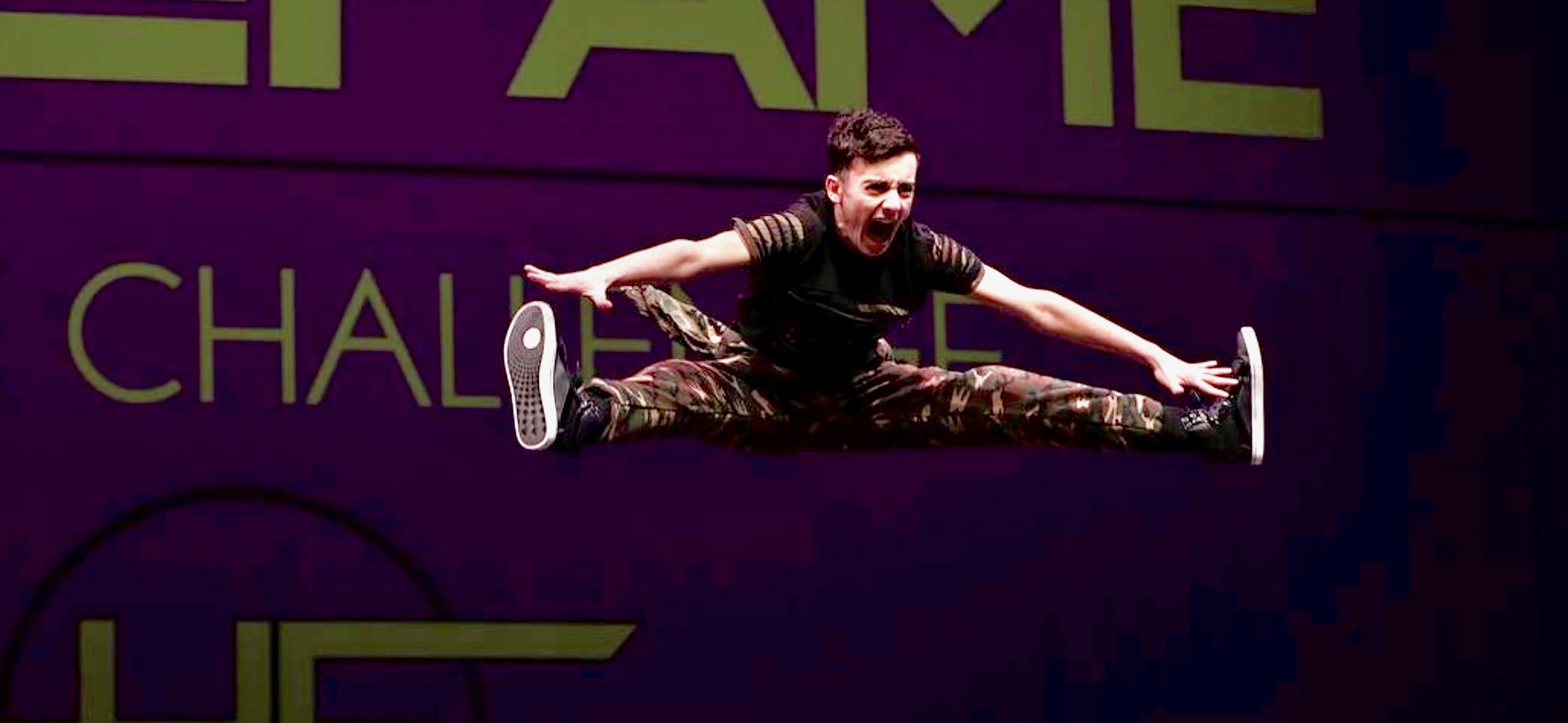
Loud jazz vibrates the orange and blue patterned floor in the ballroom of Foxwoods Resort Casino. Dominic Ciriello stands to the left side of the stage in front of a massive screen displaying a young girl doing pirouettes. “Welcome to my life, just watching dances, the whole goddamn day,” he remarks, swaying to the beat. Dominic has short brown hair and wears his black and purple tracksuit. He smiles when the next contestant comes out performing to a hip-hop song. He bends his hands in front of his face and shifts his weight from side to side.
On a recent Spring Saturday, the Showstopper regional dance competition brought together parents, teammates, and dance coaches to the Eastern Connecticut casino. The room is filled with a hundred black foldable chairs. After a dancer performs, their supporters race to the side of the stage to congratulate the dancer. White fluorescent lights brighten the sides of the stage, leading to the stairs the dancers use to wait in the wings before they take the stage.
“I’m not allowed in the girl’s dressing room where the whole studio is right now,” Dominic says. The girl’s dressing room takes up the whole back half of the ballroom, directly behind the stage. It fits about twenty different studios at a time, holding thirty white portable tables. “All the boys at competitions dress in tiny little tents so sometimes it gets lonely,” Dominic sighs, nodding over at the tiny black curtain. A cardboard sign reads, “Boy’s Dressing Room.” He turns to the screen in front of him, “That’s what happens when the boy’s dressing room is like two feet. I’m stuck out here.” Dominic looks at the tent with his teammates and sighs.
Dominic is a competitive dancer at Dance Legacy in Berlin, Connecticut. He began dancing at the age of four after his mother, Nicole Ciriello, a dance teacher at the studio, put him in a class. He decided to stick with it, focusing his training in hip-hop. Dominic is one of the very few males that take classes at Dance Legacy. His ability to relax his body and let the music take control sets him apart from many other contestants at dance competitions.

At competitions, dancers are split into different age categories. Dancers only compete against people roughly a year older or younger than them. Within each age category, there are different levels: novice, intermediate, or advanced. Dancers are also divided by the style of dance they compete: jazz, lyrical, contemporary, hip-hop, tap, ballet, acrobatics, musical theater, and open. There is also an overall category where all competitors compete for top ten.
Dominic begins his pre-dance ritual. He pops in his set of AirPods in the back corner of the ballroom and begins practicing his routine. He goes over the moves over and over again, until he hits each move perfectly. “When I’m dancing, I’m locked in. I’m so caught in the moment it’s less about me feeling and more of my muscle memory kicking in when the music starts. When I get off the stage I am tired. I am literally out of breath. I don’t ever get nervous, I just go out there and do what I have to do. Whatever happens happens.”
Dominic adjusts the front of his costume. He wears a dark blue athletic shirt with camouflage printed short sleeves and black joggers. He pushes his feet around to make sure that his sneakers hit perfectly on the floor. He rolls his shoulders back and gets ready to line up in the wings.
The crowd cheers as the contestant before Dominic gets called on stage. A girl in a sparkly black costume begins her tap dance routine. “I need to lock in because I’m competing against a girl. I have to make sure I am locked in.” Dominic shakes his hands while quickly marking his dance in the two minutes and fourteen seconds he has before he hits the stage.
The lights dim as Dominic walks onto the black marley-floored stage with his shoulder back. (Marley is the spongy vinyl flooring used by dancers.) Dominic’s routine is called “Graduation,” it’s a hip-hop dance paying tribute to his last year of dance. He’s been rehearsing the entire winter for the regional competitions in the lead up to nationals, which are held on this same stage in June. That will be his final dance competition. A sea of cheers call out as he sits down on the prop for his dance: a school desk. His body and mind link together once “Party Up” by DMX starts playing. He hits every move with a forceful flick of his upper body, his legs stepping over each other as he swings his fisted arms over his head. The music switches to “Work Hard Play Hard” by Wiz Khalifa. The choreography flows through his body. The music stops as Dominic jumps on top of his desk and puts his high school graduation cap on his head. The crowd cheers as he takes a bow and walks off stage.

He runs down the stairs of the portable stage and into the arms of girls in black and purple. They hug him, praising him for his performance. Out of breath from dancing, Dominic takes in the hugs, grinning widely. He hugs his mother and coach, Nicole Ciriello. She wears her brown hair in a tight bun on top of her head. Her black and purple outfit matches the studio’s teamwear.
Nicole has been a dancer for forty years, and a dance teacher for twenty-three. For years Dominic was the only male student in the studio. “At the dance school we are up to at least six boy dancers this year, which is awesome. I hope it continues to grow.” According to the online career site Zippia, women make up nearly seventy-five percent of professional dancers. “Male dancers have become more accepted since I started teaching. I think there are more influences now, TV and dance shows that have all these incredible talented male dancers in them.” Nicole is happy with the growth in new male students to the studio, but growth is slow. “The biggest stigma is people thinking that boys are gay just because they dance. And that’s just simply not true. I have danced with plenty of boys that were not gay, and boys that danced and still played sports.”
Dominic takes a long sip of his water bottle. “I feel great, that was amazing. This was my last first regional dance competition since I’m a senior so it is a little emotional,” he says, trying to regulate his breathing. In a few weeks he will graduate from Plainville High School. He slowly walks up to his post near the boys tent and resumes watching the competition.
Two hours after Dominic performs the stage is cleaned out for awards, a hundred golden trophies and medals with blue ribbons sit on tables. “To some extent I feel like girls are held to a much higher standard, especially when competing against a boy since that is less common. Guys have it harder because the girls can lift their legs above their heads and do all this crazy stretchy stuff and I can’t do none of that,” Dominic says while getting ready to take the stage with his teammates. All the studios sit sectioned together in clusters of colors representing their studios. Dominic explains that competitions can go either way. Judging is subjective. Points are given for technique as well as personality.
A blonde-haired announcer in a blue sparkly dress walks on stage. Dominic wins first place in his category, but the true winners are the overalls. Dominics bounces his legs once the announcer calls for a drum roll for the top ten. Tenth place goes to a short blonde girl in the lyrical category. Ninth and eighth place go to two girls from another studio.
“Seventh place overall in the fifteen to eighteen age category goes to entry number forty-two, Dominic Ciriello.” The crowd cheers as Dominic marches center stage, eager to accept his trophy.
“I’m very proud of myself. I got platinum which is the highest you can get besides a perfect score. I’m very happy since there were like fifty other talented people up against me. Like I said before, this is very emotional since it’s my senior year.” Dominic turns the trophy around in his hand. “I’m going to get some ice cream then I’m going to sleep. I am exhausted. Can’t wait to do this all over again for the next two days,” he says, packing up his black dance bag.
“I got to lock in. My second to last competition before Nationals. I need to stay focused.”
Two weeks later, Dominic stands in the wings of the Middletown High School auditorium, clutching an energy drink. “I got to lock in. My second to last competition before Nationals. I need to stay focused.” He slams his drink down and hops up on the enormous stage, a traditional proscenium stage shrouded in velvet black curtains. The back of the stage has a backdrop marbled with blue, green, and pink. In the center the words, “Elite Performance Challenge” written in white. Dominic adjusts his silver headphones on his head, replaying his hip-hop song, a mix of different rap songs together called Graduation on a loop. He stands in the center of the stage lunging from side to side, surrounded by competitors from other studios warming up. He wears his royal blue shirt with camouflage short sleeves, complemented by his black joggers. He springs high into the air, effortlessly kicking both feet to either side of him in a straddle and reaches out to touch his toes. Dominic practices his moves until the lights dim and the announcer says the competition is about to begin.

The stage lights darken as the contestant before Dominic walks out. Hip-hop music booms as the stage lights beam down showing a young boy with light red hair. He wears a red hoodie and black joggers. The auditorium holds three hundred seats, the majority filled with dance studios and family members. The judges sit in a long black desk in the front. For two minutes and thirty seconds, the boy does a hip-hop dance with similar moves to Dominic. He has the same amount of power and personality that Dominic had two weeks ago. The boy finishes his dance, slightly out of breath. The crowd cheers.
Dominic walks on the stage with his head held high. The crowd cheers as he hits his first move, sliding off his prop desk, throwing papers on the marley floor. The energy from within him explodes into the audience. A gaggle of girls in track suits leap to their feet screaming. He spins around on the floor, balancing his body on his left shoulder. He jumps to his feet, throwing his body back on the ground doing the worm. He rocks back towards his desk, lays his eyes on the judges, puts his hands on either side of him and thrusts his body forward, winking at the judges. He stands on top of the desk, placing the cap on his head, then throws it down to the crowd. The cheers and claps from the audience almost overpower the pop music that plays in between the dances. He smiles at the crowd, rolls his shoulders back, and walks off the stage, eyeballing the judges.
Dominic walks over slightly out of breath, water bottle in his hands. “That was great,” he says, trying to control his breathing. “I competed against another boy in hip-hop, I got some competition,” he says, adjusting his black jacket.
After twelve more dancers compete in a variety of categories, the dancers gather with their studios for the awards. The day has featured just two boys. The blue and gold trophies line the back of the stage. A woman in all black with a messy bun stands at the center of the stage congratulating all the dancers. Nineteen contestants are competing for overall awards. One by one, the names are called. Seventh place goes to the red haired tween boy competing against Dominic.
“The fourth place overall regional champion for ages fifteen to eighteen in the advanced category goes to entry number 207, Dominic Ciriello.” The audience cheers while Dominic jumps up from the left front side of the stage where his studio sits, and accepts the award.

After the overall winner is announced, Dominic gets called back to the stage. The announcer tells him that the judges felt like he did an exceptional job with his dance, earning him a Judges Award. She hands him a blue, green cardboard certificate that says, “Captivating Charisma”. Dominic takes the award and takes a bow. Girls in tracksuits all the colors of the rainbow and moms and dads who’ve been up since six in the morning rally. The stage lights flicker while music rumbles through the room.
Dominic stays on the stage after the awards end, taking pictures and celebrating with his team mates. “One more competition, and then it’s over until nationals,” he says, twisting his golden trophy around in his hands. “I’m going to miss this.”
Abby Bechard is a staff writer for Blue Muse Magazine.
Pictures courtesy of Abby Bechard, Nicole Ciriello, and Hall of Fame Dance Challenge
Great pics with this feature and love the opening sequence!