

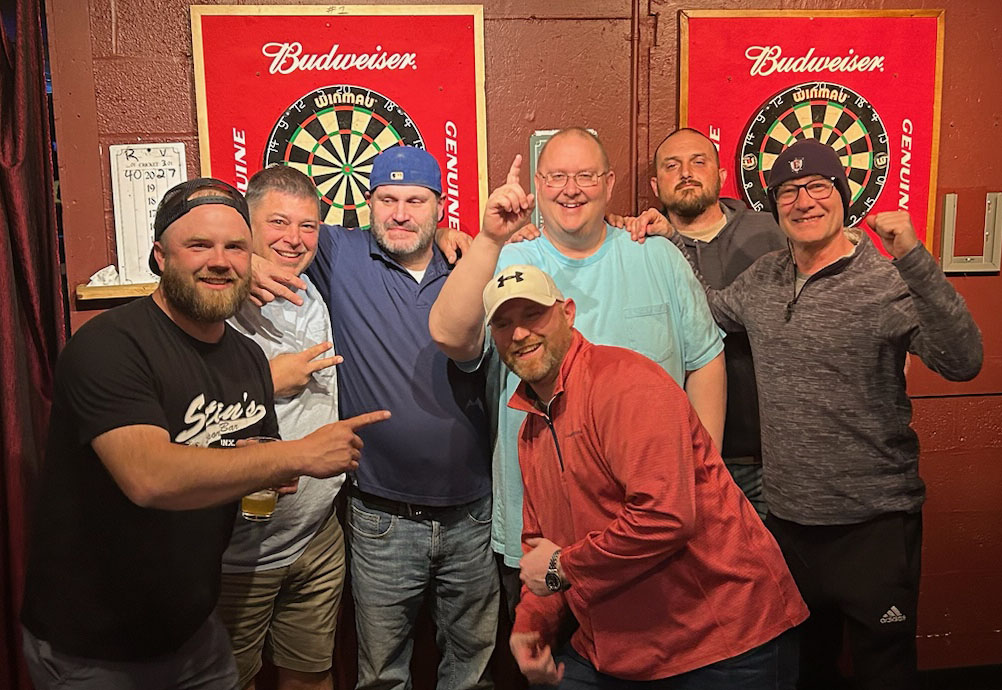
Nestled in the heart of Downtown Milford, Connecticut sits a little pub shyly tucked away at the end strip of local restaurants and shops. The flashing dark green and yellow sign reads Casey’s Irish Pub. Every Thursday night starting sharply at 8:00 p.m, local Milford men gather inside Casey’s to chat, drink, and most importantly, shoot darts.

Inside Casey’s the musky scent of beer and man mingle. The entire bar is dimly lit aside from the very back, which is encased in bright yellow light adjourning two dart boards hung on a light gray wall. The wraparound bar takes up most of the space itself, leaving room for a juke box squeezed into the very back right corner blaring The Rolling Stones. Ted Edwards, fifty-eight, has been coming to Casey’s on and off for the past twenty years. “I just came in here when I moved from England. They were playing darts and they asked me to play and that was it.” Ted’s the typical looking Englishman, fairly skinny with a row of yellowed teeth caused by the dozen hard candies he chews on throughout a night of playing. His protruding beer belly would make a nice coaster for the fourth pint of beer he sips casually. Ted is a member of the eight player local dart team cheekily named “Casey’s Dub Sacks”. Tonight, the Dubsacks are facing West Haven, a fellow division A team.
“Darts is a pretty simple game really,” Ted says, shifting his feet. “Some of them get excited but I don’t. Some of them take it too seriously and they get upset when they lose.”
Ted’s eyes shift to his other, younger team members across the bar. Two men in their early thirties sporting long dark beards and tight fitting graphic tees clink shot glasses filled to the brim. Throwing back their heads, they down the brown liquid and wobble to the red and black dart board, awaiting their turn to shoot.
Directly opposite the dart boards on the other side of the wraparound bar, sits Jesse Viscardi, a retired Casey’s dart player. Jesse looks like your typical gruff construction worker, donning dirt stained jeans, brown roughed up work boots, and light gray T-shirt. His eyes watch the dart board, keeping score in his head. At the board Ted is up. The Dubsacks are winning. Ted throws, almost scoring a bullseye.
“I just came in here when I moved from England. They were playing darts and they asked me to play and that was it.”
Jesse is quick to explain the game. “So the way that league works here is, you start with a game of 301.” Essentially, each player starts with a score of 301 points and takes turns throwing three darts. The score for each turn is calculated and deducted from the player’s total. Hitting the bullseye scores fifty, the outer ring scores twenty-five, and a dart in the double or treble ring counts double. The objective is to be the first player to reduce the score to exactly zero, the only caveat being that the last dart thrown must land in a double or the bullseye. Jesse takes a sip of his beer and pulls out his phone, quickly scrolling at his notes to see if he’s missing any more dart rules. “You play the best two out of three. So, whoever wins two games will win the points. You have six matches of that. After those six matches, you go into a doubles match of cricket.”

In the game of cricket, the targets are only 15, 16, 17, 18, 19, 20, and the bullseye. Once a player gets three marks, the number will be open. A player scores points by hitting the area he opened. You can void your opponent’s open area by getting three marks on the number. The player with the highest score when all numbers are closed wins. Jesse’s mouth moves fast, his hands moving in circle motions while trying to get his point across. “The game usually takes three and a half hours. Roughly, you only have six players, that’s the lowest you could have, larger teams could be upwards of eight or ten.”
As Jesse explains the game, a middle-aged man is finding his tutorial hard to follow. The man sports a black and gray bandanna that covers thick black hair extending well past his shoulders. Drunkenly, he leans on another man, who cringes at his friend’s state of intoxication at 9.00 p.m. on a Thursday night. Bandanna man slurs his words, occasionally hiccuping while pouring his heart out about how his friend is a beautiful soul and he’s going to provide the man free shots for the rest of the night. His friend laughs and takes the offer of another shot, but soon finds another seat at the other end of the bar.

At the dart board it’s Rich Morgan’s turn to shoot. Rich has been a frequent Casey’s dart player for the last five years, yet with all those years of experience, he’s still the worst player on the Dubsacks. Taking several deep breaths, he scrutinizes the eight foot space in front of the board. Lightly gripping the barrel of the dart between his thumb and index finger, he mimics the motion of throwing, slightly leaning forward with each fake release. Finally, he hurls the dart at the board. It comes up short, landing on the outer edge, almost missing the board entirely. He shakes his head, shouting profanities loud enough for the people smoking outside to hear. Turning around, he saunters back to the bar, the throw already forgotten after he orders another pint of beer. His teammates sit a few chairs away. They playfully argue about what band to play next on the jukebox. Rich wants ‘90s rock, his teammate wants any music he knows Rich will hate.
Rich comes to Casey’s not only to show off his riveting dart skills, but to hang with his buddies. “Everybody that’s on my team, I absolutely adore, and I have developed great relationships with everybody outside of darts. I’ve seen fights break out over nothing.” Lowering his tone, he leans in closer. “I’ve seen people act like fucking retards just being here and not knowing how to play. I’ve played against guys that were high on coke that were good at darts—only because they were high on coke—they suck when they’re not. But most of the time, I have had a wonderful relationship with everybody that has played because they’re all classy, wonderful human beings that I enjoy hanging out with and it’s been fun.”
The clock strikes 11:00 p.m.and the game begins winding down. Ted and Rich throw their last darts. Ted throws well, Rich tries his best. As the Dubsacks down their last beers, the score keeper counts up the nights points on a handy little electronic dart scoreboard. The Dubsacks won.
Some players head home to their families while the others hang around for another round of beers to celebrate the victory.

Outside of Casey’s, the April stars illuminate the sky, casting a serene glow over the bar. A line of men lean on the bricked wall near the entry door, savoring their cigarettes. The smell of weed floats down the sidewalk. Next week the Dubsacks play a bar called Big Wigs, a fellow division A team in Milford. The stakes are nothing less than a shot at the coveted championship, the prize being a gleaming plastic trophy, a round of beers, and bragging rights at Casey’s, the most valuable prize there is.
Gia Edwards is a staff writer for Blue Muse
Images courtesy of Ted Edwards
0 comments on “Dart Night at Casey’s: A Milford Third Space | Gia Edwards”