

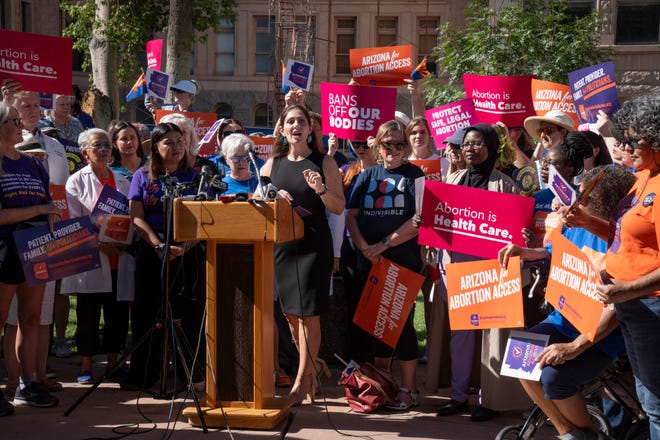
On July 3, 2024, Arizona voters delivered signatures to put abortion access on the November ballot. Arizona for Abortion Access, a coalition of health, rights, and justice organizations, collected eight hundred thousand signatures, the largest in state history. Standing at a podium, Tucson organizer Dawn Penich told a hyper crowd, “To put that into context, that means one out of every five Arizona voters signed this petition,” as the crowd erupted into cheers. One speaker wore a T-shirt that said My Body, My Decision.
When the Supreme Court overturned Roe v. Wade in 2022, laws regarding abortion access reverted to the individual states. Later that year, red-leaning Kansas voted to preserve a woman’s right to choose. This year, Arizona is one of twenty-six states with abortion rights measures on the ballot. Reproductive rights is now the largest single issue driving Americans to the polls.
Vice President Kamala Harris has honed in on reproductive rights during her campaign, while former president Donald Trump believes the issue should be decided at the state level, ignoring the fact that he once boasted about appointing the Supreme Court justices who overturned Roe.
“Religion and whatnot and the need to control women’s bodies has no place in politics.”
Gallup polling found that 32 percent of voters said that they would only vote for a candidate who shares their view on abortion–a record high. Within that percentage were “nearly twice as many pro-choice voters (40 percent)” as pro-life voters (20 percent). “This is the third consecutive year that abortion-centric pro-choice voters have outnumbered abortion-centric pro-life voters in the US,” wrote Gallup editor Megan Brenan and director of US Social Research at Gallup Lydia Saad. It has also become apparent post-Roe how only when the right to abortion was taken away did citizens’ thoughts on abortion flip. Gallup data has shown that “in 2005, when abortion was legal nationwide, the opposite was true, with 53 percent of pro-life and 37 percent of pro-choice Americans saying it was important.”
This abortion issue has become such a large-scale entity within the upcoming election that it has surpassed the notion of taking two sides, instead inserting itself as a threat against a fundamental right to privacy for women.
More voters are beginning to realize the severity of what restrictive abortion bans mean. MSNBC covered a challenge to Georgia’s heartbeat abortion law, which had been passed after the overturn of Roe v. Wade. On September 30, 2024, Fulton County judge Robert McBurney called the law “a violation of the constitution,” making abortions now legal up to twenty-two weeks of pregnancy instead of six. On October 7, 2024, the Georgia Supreme Court “temporarily reinstated” the six-week ban as the appeal works its way through the courts. Even Republican-leaning states have begun to see more challenges to their restrictive abortion laws. With ballot initiatives and candidates hammering the issue on the stump, more and more voters are going to the polls this November with this single issue determining whom they’ll cast their ballot for.
“With ballot initiatives and candidates hammering the issue on the stump, more and more voters are going to the polls this November with this single issue determining whom they’ll cast their ballot for.”
Our presidential candidates are gearing up now more than ever to earn the trust of either pro-life or pro-choice voters. Both candidates are filling the airways with ads and making promises for or against a national abortion ban, but are these the right kinds of conversations? Gender studies scholar and Central Connecticut State University professor Jessica Greenebaum has seen firsthand how misinformation regarding abortion and reproductive rights has spread across the nation.

“In giving a general background on reproductive rights, I’ve found that a lot of people used to say, ‘I’m pro-life, I would never have an abortion,’ but that’s pro-choice. As we know, language is power, and the language is being altered. ‘Pro-life’ and ‘pro-choice’ are not even the right words anymore,” she says, sitting in her office on the New Britain campus. Greenebaum emphasizes how reproductive rights are just those: rights, and how the political conversation has been shifted to taking sides as opposed to a government looking to take away a fundamental right. She reminds citizens of the historical origin of Roe v. Wade. “Basically, this was the argument to allow women to have privacy. It wasn’t really a right to abortion. It was the right to privacy that a woman gets to make the decision with her doctor about what is right for her.”
One woman who made this very private decision about her own body is twenty-one-year-old Liv. “I’ve been saying this, but religion and whatnot and the need to control women’s bodies has no place in politics,” she says, sitting on her queen-size bed in her suburban home, walls once purple now beige, with remnants of her teenage life: photos with friends, Olivia Rodrigo and Taylor Swift vinyl hanging on the walls. “People walk around spreading this idea that abortions are just this easy and fun little thing that women get just because we want to when that couldn’t be farther from the truth.” She believes that abortion is taken lightly by both pro-life and pro-choice advocates at times, saying it “Was the hardest thing I’ve ever had to do but something that I knew I needed to do.” Liv’s experience changed the way she’ll be voting, though she adds, “I do think that even if I didn’t have my experience, women’s rights is something that I’ve always felt very strongly about.”
On November 5, a new president will be elected to office, representing all Americans. The future of reproductive rights lies in those elected hands, but before that, in the hands of the voters.
Lorena Sula is a staff writer for Blue Muse Magazine.
Feature image: Dawn Penich, press director for Arizona Abortion Access, speaking to gathered Arizona citizens to speak before the secretary of state before Arizona Abortion Access submit their signatures, courtesy of Mark Henle for The Republic
0 comments on “Reproductive Rights on the Ballot: State Initiatives Post Dobbs are Driving Voters to the Polls | Lorena Sula”