

It may be a dull and damp New England winter outside, but inside a veterinary examination room in Cromwell, the mood is decidedly more lighthearted. This is largely due to the eager slurping of Panda, the young american bully, as she buries her face into a rubber mat loaded with peanut butter and liver powder. With each lap of her tongue, the mat slides a little further across the floor.
“She’s not food aggressive,” says Dr. Katie Fiore, the veterinarian overseeing Panda’s first visit to the clinic. Dressed in dark green scrubs and crocs, her hair pulled back into a ponytail, she smiles as she watches. The owner, Samantha, confirms Panda’s docile, and Dr. Fiore proceeds with her initial inspection. The food comment was partially a joke, yet knowledge of this sort is important for veterinarians to know when it’s safe to handle certain pets. Food is often used to provide a distraction or allow more comfortable handling.

Panda steps up on a rising platform. Dr. Fiore takes a blood sample and asks probative questions about the animal’s history and the reasons for her visit. She has to be thorough during the fifteen minute exam to keep on schedule. Then it’s a dash back to the office for her write-up before her next four-legged patient arrives.
Dr. Fiore works as a relief vet for IndeVets, a Philadelphia based relief veterinarian company. “If there are practices with doctors that are out, if there’s any help requested, whatever the reason being, I can step in and be able to provide them with exactly that relief,” she explains. Unlike independent relief veterinarians, who are contract workers, IndeVets guarantees a salary, and holds contracts with over five thousand animal hospitals across the United States to provide shifts for its vets.
“I can have combinations of well and unwell appointments. Wellness visits can be getting your yearly shots, screening labwork, getting preventatives. Asking questions like ‘are you seeing mobility changes in your senior pet?’ Appointments like that, I feel very compassionate about. Not just wellness things, but ‘Hey, I noticed that Fluffy is having trouble getting up and down the stairs.’ We can walk through what we can do to help with their physical health, maybe some cognitive changes as our pets get older. Those, I feel, are very rewarding visits for me.”
“It’s tragic when we have to say goodbye.”
Dr. Fiore knows all too well the struggles and decisions that come with an aging pet. Her home is still richly decorated with photos and art depicting her late dog, Romeo. “It’s heart wrenching to see your best friend start to slow down, start to feel uncomfortable, and you want to make sure that they’re happy and comfortable. My old dude, I had him for quite a while.” Her smile falters from a memory of Romeo. “I am very happy for how long I was able to keep him happy and healthy. It’s tragic when we have to say goodbye. I’m very fortunate to be able to have a wonderful network of fantastic veterinarians, specialists, and general practitioners that helped me personally with my own critter, but have also helped me with patients that I have transferred for additional care.”
Phantom, a domestic shorthair with an inexplicable large scabbing wound in front of her left ear, shivers as Dr. Fiore enters the exam room. The cat’s wide eyes follow her around as she moves to the other side of the table, hands resting calmly on the edge as she discusses with Phantom’s owner. For now, the solution is relatively simple: an e-collar and some ointment to prevent itching and to discourage her from re-opening the wound. Before she can show the owner how to use it, time has run out, and she has to dash to the door to catch her. “Hey, Mom?” Dr. Fiore calls Phantom’s owner before she can leave with instructions on applying the ointment. She displays an endearing affectation to clients who arrive to receive care for their furry kids.

The pandemic also has added to the stresses of the veterinary profession. “During Covid, we were looking at around two thousand pets per veterinarian. I was struggling to find an updated statistic on that, and it really is close to about three thousand pets per practitioner.” The numbers are telling, when each visit is limited to half an hour. Some practices can limit them to even ten or fifteen minutes, which includes check-in and general vitals by the veterinary technician. After Panda’s visit, Dr. Fiore is already behind on her next appointment, being one of only two veterinarians working here this afternoon.
“They’re happy to have someone come in,” she says, “I never want to walk into a practice and see that everybody is very burnt out and frustrated. I support them as best I can. My way of caring, or love language, is little acts of service and little gifts. So if I see a practice is struggling that day, I’ll pick up some donuts, I’ll pick up some other treats.” Otherwise, she travels light. As Hugh Lofting puts it in The Voyages of Doctor Dolittle, “I don’t believe in a lot of baggage. It’s such a nuisance. Life’s too short to fuss with it. And it isn’t really necessary.”
Today the mood is upbeat in the back. Technicians and assistants joke with each other, and the other doctor on shift takes a brief break from his notetaking to give Dr. Fiore a brief lesson on swing dancing, which quickly devolves into uncontrolled giggling. She recently acquired a new kitten, now named Graham, from Abby, the veterinary technician that she works with at this clinic. Dr. Fiore enjoys meeting new doctors and expanding her network of veterinary professionals.

“Every time I work at a new practice, I learn of new people in the area. I’m getting a little bit more familiar with the larger facilities. I’m meeting new doctors, and it’s nice to be able to grow that network.”
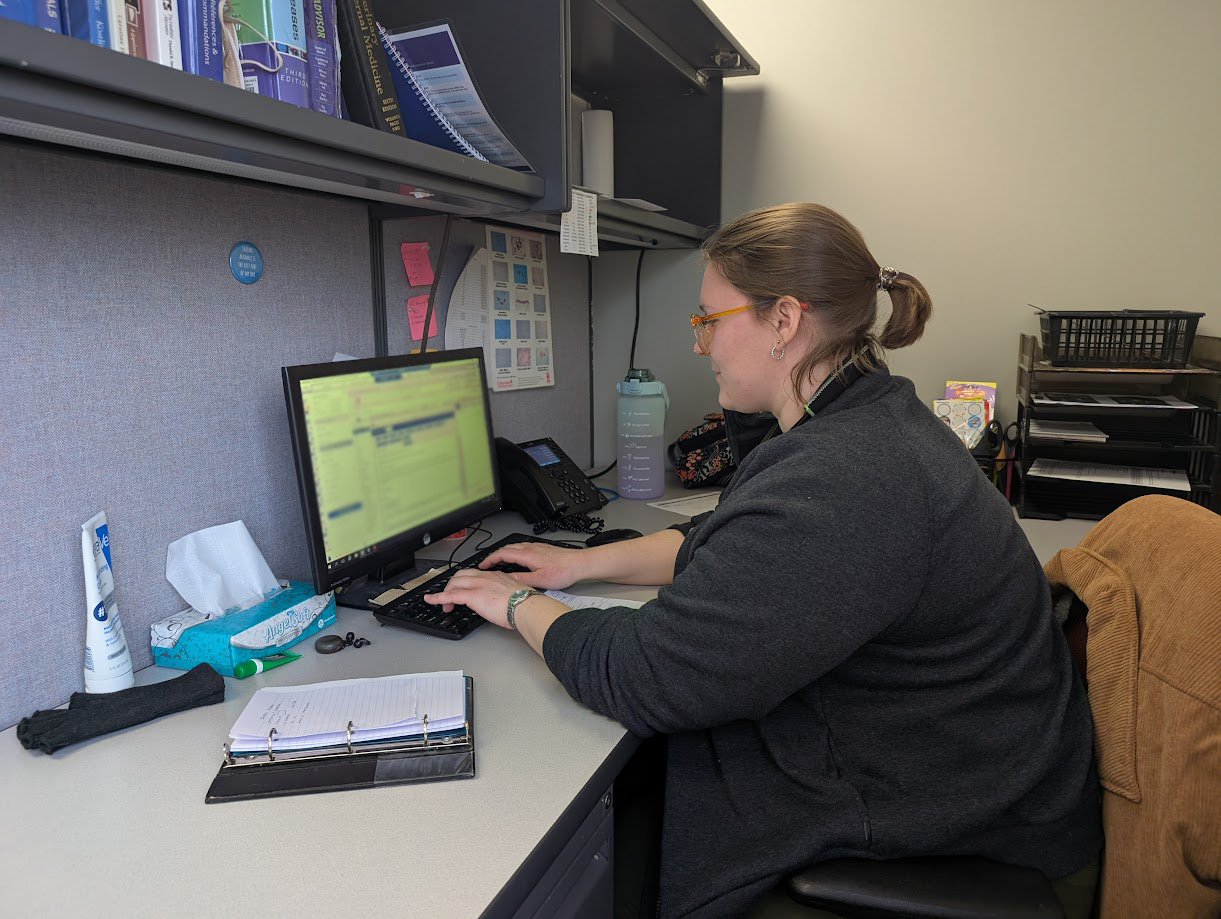
“I’m typically here on Thursdays,” she explains later, taking a brief pause in her write-up. Through IndeVets, Dr. Fiore can generally choose what shifts she picks up and where. “My quality of life, my work-life balance has improved quite a bit since I’ve started to do relief work. When I was in a singular practice with the veterinary shortage, there’s a lot of stressors, and it’s hard to navigate around all of those.”
IndeVets also allows her to set her practice radius. Dr. Fiore used to practice most in northern Connecticut, and is now practicing more in the south after a recent move. “To have that freedom has been very nice,” she says, “And when I’m going into these practices, many days I walk in and they’re just glad to have somebody there.”
Leo is an enthusiastic, energetic goldendoodle puppy, receiving his first vaccinations and obtaining his medical history. He gambols happily from person to person around the examination room, tail wagging, never pausing for an instant. All golden curls and big eyes with oversized paws, it’s difficult not to give him attention. Face screwed up in concentration, he buries his nose into the ankles of anyone in his path. Eventually, Dr. Fiore and Abby are forced to hold him in place on the platform with many cooing endearments to receive his shots.

There is a shortage of veterinarians in general because of the financial burden of veterinary school, and the schooling itself is challenging, with a rigorous course load and a difficult licensing exam. As Hugh Lofting’s famous character, Dr. Dolittle, says, “Money… is a terrible nuisance.” According to the American Veterinary Medical Association, “More than 80% of veterinarians graduate with student loan debt, which averages more than $200,000.” In 2025, the USDA declared 243 rural veterinary shortage areas in 46 states. “You go into it because you have a passion for helping animals. You’re trying to make a difference, but you don’t walk away with a whole lot of money,” she laughs, “So getting people into the field is very challenging. There is just generally a shortage of veterinarians, and an ever-increasing pet population.”
It’s almost a relief later in the afternoon when another client doesn’t show up, allowing Dr. Fiore to catch up on her case notes. Downtime is hard to come by, which only accentuates the growing need for more veterinarians as pet numbers swell. Although what IndeVets and their professionals do can be a boon for struggling smaller practices, Dr. Fiore and others like her can only treat one fur-baby at a time.
Tomorrow, Dr. Fiore will be at another clinic, and the cycle will start over again. She knows it won’t always be easy, but for the furry friends that reap the benefits, it will always be worth it.
Feature Image: Dr. Fiore / Photo Credit: James Coburn
0 comments on “Calling Doctor Dolittle: The Life of a Relief Veterinarian | James Coburn”