

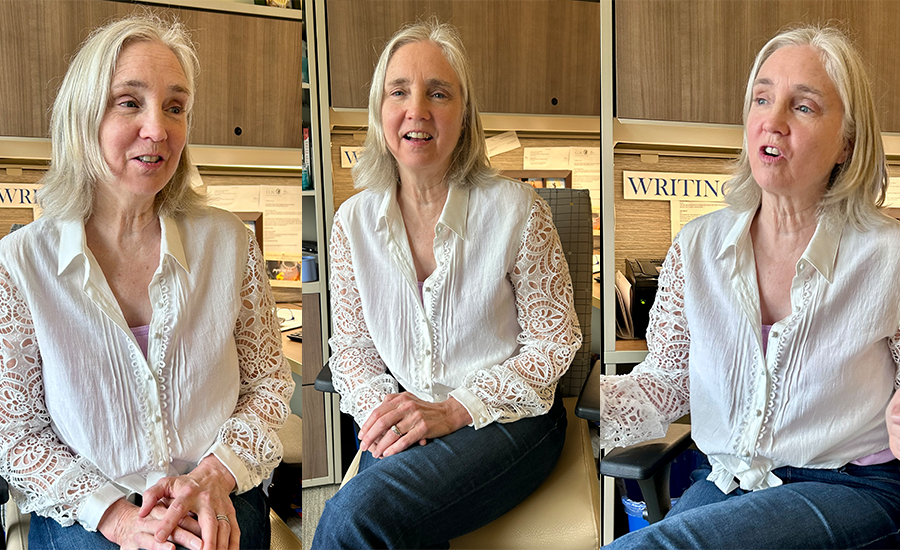
For nineteen years, Professor Mary Collins has been a beacon of creative nonfiction, teaching at Central Connecticut State University. Countless students have taken advice, inspiration, and comfort from her calming presence. She is soft spoken but with an intensity of belief in the power of writing and creativity. All things come to an end, and this is Professor Collins’s last semester at the school. So, we sent Blue Muse staff member James Coburn to her New Britain office to discuss her creative life and career.
I had never had Professor Collins as a teacher. Now, I find that fact all the more depressing, knowing that I will not have the chance in the future. She was immediately welcoming, offering me a seat and patiently waiting as I got the recording equipment set up. I was struck by the immediate curiosity she had about someone who was there to interview her. Soft spoken she may have been, but her vibrant tone and her willingness to dive deeply into her own history without hesitation struck me. Sitting there in her office, dressed in a gray cardigan, with tea in her hand and her eyes occasionally glancing out the gap in the window curtains, she had me wondering what I was about to hear.

It’s a little difficult to dive in anywhere but the beginning, so we can start there. Why humanities? Why writing? Where did this fascination with exploring the world around us in creative text spring from?
I was a pretty crummy student, but I was always a great reader. I think that saved me in my elementary, early middle school years, that I was educating myself and building my vocabulary. By the end of high school, I was doing great, and in college, I was a great student. But I never was not a reader.
I’ve been teaching since 1986, when I was a grad student at the University of Virginia, getting a doctorate in literature. I had taken a year off and just worked, and then went to UVA. They had a great grad program. About four years into my PhD program there, a friend had a magazine internship in Washington, DC, and didn’t want to take it. So I went to DC and got an internship at the Washington Journalism Review, which is like a muckraking, really far-left magazine.
Once I took that magazine internship, I realized I like dealing with contemporary life and contemporary stories. I just slowly took crappy low-level jobs, working in a newspaper for a year, working as a temp at a magazine, and I kept seeing that I didn’t really want to be a newsperson. I was like, “I don’t want to do this. I’m much more of a roamer. I’m more of a storyteller.” I loved contemporary stories and features.
When I was in college, I was a history major, so I floundered around and had a lucky break at the American Journalism Review. They needed a temp. I busted ass for six months. A guy named Bill Monroe was the head editor. Instead of going to journalism school, I had Bill. He eventually gave me the job. And he rejected, like, seven stories. After literally a year of being rejected, I wrote a story about how the congressmen on Capitol Hill produce these videotapes and send them to the local news stations in their states. And the states just run them as real news, but really, they’re just PR videos from the congressmen. So I wrote “News by the Congress, for the Congress,” and Bill took it. It was one of the great moments of my life.
This work led to your first book.
I was meeting all the journalists in the city. One of the guys, Jack Hamilton, came by. He’s like, “Oh, I got this contract to write a book on the history of National Public Radio, but I don’t have time to do it. Why don’t you take it?” And I’d been in the magazine for a year, and I was like, “Jack, I don’t think they’re gonna want me to take the book project.” “Oh, it would be great. You were great. You got all this energy.” He told the publisher, “I found an author for you.” And he didn’t tell him I had zero experience.
And then in the middle of that, I got pregnant out of wedlock. I never told them till the very end. I started having morning sickness, and I told them, “You know, I have the flu.” So when my baby was born, they called it the Flu. That was me being willing to take a huge gamble on something I wasn’t sure I had the skills to do. I did end up doing a great job on that book. That was a huge breakthrough moment, by just being in the right place, and somebody seeing potential in me.
I was probably about twenty-seven, twenty-eight when that finally happened. Somebody took a gamble on me, and I was willing to take a gamble on myself. And that’s what I don’t see in a lot of my talented students. You know, I can offer them free housing and an internship in Washington, and they don’t do it. Just being around people and being in the middle of everything and just putting yourself there can, like a ping-pong ball, send you in different directions.
But now you had a child, and no support?
I had to go back to Connecticut for two years to be with my kid while I tried to figure out what I was going to do. I lived with a sister, looking for work. Harvard Medical School has newsletters that have a half a million circulation, and a lot of health reporters take them, and people get them at their homes. They had a managing editor’s job. I go in, apply, and do the worst of all the top ten candidates on the copyediting test. The head editor loved my energy and that I was full of ideas. She pulled rank and said, “We want to hire her. I want to give you free daycare on location for your two-year-old little girl.” I go up there for three days, and I’m like, “I can’t do this. I’m gonna be editing, I’m gonna put my kid in daycare. I’m not gonna be able to write. I can’t do this.” And so I turned it down, which was the hardest decision of my professional life. My sister kicked me out of her house because I refused to take the job.
I took ten thousand bucks that I had from my mother, and I moved to Baltimore because it was cheaper than Washington, DC. And I was like, “I’m gonna go back to being the writer I want to be. I don’t want to sit at a desk, I don’t want to interview other people. I want to be a writer. And I also want to be with my own kid.”
I had a huge lucky break. Johns Hopkins’s graduate writing program had decided to open a Washington, DC, campus. And that’s how I got into teaching as a very serious part of my life. For thirteen years, I ended up at Johns Hopkins teaching a two-two load, running their nonfiction programs, running their events, which was a blast, but it was a per-class job. There were no benefits, no salary. And so once again, I faced this huge obstacle of like, “Hopkins is sort of taking advantage of me as this hard-working part-timer without any benefits.”
I took jobs I didn’t like. I was a fact-checker researcher at National Geographic. I was way overqualified, and I wanted to get into National Geographic. I realized that it was the kind of writing I wanted to do. Washington was a great place if you wanted to be a narrative historical writer, or a biology natural history writer, or something like that. I was balancing that for about thirteen years. I did Hopkins, National Geographic, and then I got moved over to the Smithsonian. And it just sort of escalated all those skill sets of like four years of reading literature. By just throwing myself constantly into situations where I had this general skill set and a lot of energy. “You show me what to do, and I’ll apply it in your environment.”
I made a career out of it down there. But again, once I got divorced, my mother was in Connecticut, and Washington was hard. It’s a big city. It’s very transient. People come and go because of each administration.
How did you end up returning to Connecticut?
I got offered a job at Bard, but it was kind of far and way up in the middle of nowhere in New York. I got offered a job in San Francisco, but that was away from all of my family and friends. When this job at Central came up, it was the best match. Near my mother, near the roots of growing up in Connecticut.
So that’s how I ended up at Central, bringing all that experience. I was in my mid-forties, really a third career, if you think about it. Using the same skill sets in a lot of different ways. I have these loose skill sets, and I think now I’m gonna move them into the classroom. Of course, I’d been teaching at Hopkins for twelve years, so when I got here, it was just a very different kind of teaching.
We don’t have to focus on it for too long, but it is obviously a big part of your life. The book you wrote with your son, At the Broken Places. Can you talk a little bit about what was broken and what you had to pick up together with him?
(He was a) beautiful child. Quiet, artistic. No sign of a gender concern, dysmorphia, or anything. Just nothing apparent. Very quiet, very sweet. We moved to Connecticut, he started high school, and something was off. He became depressed. He wanted to chop his hair. And I just didn’t understand what was going on. I’d not seen it anywhere. So it was a lot of stress. He was the first trans person to ever come out at his high school. And so that was really unusual, back then. Now everyone talks about it, knows what it is, but we didn’t know that.
In one of the essays in the book, I write about how Donald, who now actually goes by his middle name, Blake, was at the table saying, “Mom, I think I’m transgender.” And I had never heard that word. I didn’t know what it meant. It’s hard to imagine fifteen years ago, like, I don’t know, are you gay? I responded, “I don’t know what you’re talking about.” The fast version is, high school was very volatile because they didn’t know how to handle him, and they didn’t know how to handle me. So they just shut me out. I didn’t even know he had changed his name at school. They had a convocation about all of it and didn’t even tell me, so they handled the parent part of it in a terrible way that they would never do now. But they were afraid, and they weren’t sure what to do.
Fast forward very quickly through college and a lot of challenges. We constantly tried to keep working things out, but it was a pretty big challenge. Two things happened. One, in college, he joined a fraternity, and he wanted me to pay for his surgeries, and I wouldn’t do that. I was like, “I don’t feel comfortable. You’re only twenty, twenty-one years old. It’s irreversible. I’m not doing it.”
The fraternity raised the money for him, and that made international news. Anderson Cooper’s news team came to his door. And it was really scary. So he calls me, “Anderson Cooper’s news team’s here.” I was like, “I’ve been a journalist. They don’t care about you, and they’re just looking for a story, and they will eat you alive. Don’t open the door. Your journey is your own, and it’s already painful enough.” And he didn’t. That was the start of us healing, that he had trusted me to ask a very key question. And I had proven right.
I started writing an essay called “Mapping Modern Grief,” where I had found letters behind a frame of my Irish ancestors writing to their two daughters who had left for America, telling them, “Your brother has died, and we are left here in our old age. You have crossed to America, and we will never see you again.” And I thought, my daughter has crossed an ocean and has come back as a son. I’ll add that I wrote that essay, afraid to show it to my son, because I thought he would just feel like “I don’t want to hear your sadness.” Like “I’m really glad I’ve come out as trans, and I’m really feeling much better about myself.”
But then all of a sudden he’s like, we really, really loved each other and we were a really close family, and we somehow can’t get that back. So maybe through the essays we can do that. And he began to write in response, and that’s how the book formed. Then we went on a three-year road trip that was rejuvenating. We had that rough journey. The book captures our give-and-take and the pain of it, but we didn’t have opinions. And that’s when that project made me see the power of the public essay, of the private, personal essay. We just shared experiences, and we could come to our own conclusions. It was hard for me to see my daughter go, and it was wonderful for him to come into his own. And both those things can be true. So that project showed me the power of writing to heal. It saved my family and my relationship with him. My son was spectacular, that at age twenty-two he would agree to that.
We get along great now. He’s an adult. He’s made his own choices. We have a ton of things in common. He’s a PhD student at UCLA. He’s got a great girlfriend. He’s an astounding writer. Better, I think, than I am. And funnier. I’ll always be grateful that he was courageous enough to share what he really thought.
In the book, your son mentions how he used to explore your library and how it shaped him.
It gave him years of reading, and he was an incredible reader. He was reading Dostoevsky’s The Idiot when he was about fourteen. We were at the lake that we used to go to in the summer, and he’s reading this amazing book, and he’s put all these notes in there, but then the book falls into the lake because it’s fallen off the dock, and he’s just weeping. I just say to him, “Well, it’s okay, like, we’ll get another copy.” And he’s like, “But not that copy.” I knew in that moment I’d raised someone who understood art and literature and the power it could have over your life. He’s a real throwback right now.
Would you say that’s one of the works you are most proud of?
I’d had a life-threatening bicycle accident where I was a Jane Doe and helicoptered from the scene when I was still living in Alexandria, Virginia. And when I woke, I was almost paralyzed on the right side. And took a couple of years to get out of all that. I realized that I wanted to write about it, but it got kind of boring after about ten pages. What turned out to be an accident that nearly killed me, was a disaster, where I was totally self-involved and overwhelmed, turned into a project where I learned from others. I realized I’m not the center of the story, that the book is giving me a way to look at my larger culture.
I began to take a central character in each chapter. How do we move in a hunter-gatherer society? So I go out into a field with a guy who’s like a paleontologist—hunter-gatherer expert—and we’re picking out fossils. I realized that by using other characters, I had a much more interesting story than writing about myself. And that whole book pulled together beautiful themes of city planning and health. That’s the power of really good nonfiction.
You also won a national award for an essay about a bookcase. Can you tell me a little more about that?
Somehow in my career, I began to register that you don’t have to be in a bike accident to have your writing be interesting. And so, the bookcase. My father died when I was fourteen, and he was a judge, and my mother gave me the bookcase that his law books were in. And in my house, the books there are just books of people I know, and they’ve signed them, and some of them are funny. They’re from ex-boyfriends and everything. It’s really a riot. I’ve collected them over thirty years, and I’ve always had to go to the reading, and I’ve always had to know the author, and then I’ve always had them sign the [books], and now they fill the case. So I began to read the inscriptions, and I wrote an essay about the bookcase and the meaning that it has, and that it’s not my favorite books, but that it’s a map of my literary life and journey as I move through life as a writer. A person who wanted not the editing life at Harvard, but the writing life for myself. And that’s where it’s a victorious bookcase. This is the bookcase of the life I wanted to create. And it’s my favorite object. A personal essay that was a real breakthrough. Best essay of the year from the American Society of Journalists and Authors and stuff like that.
You also published a work called A Play Book: Creating Writers, Creating Citizens. It’s a collection of small essays and watercolor paintings that came out of the Covid pandemic. What inspired that?
I found that I had lost whimsy and joy in my work. I was feeling very flat. Yet, I kept painting things that were whimsical, like a canoe or a beach ball. So I was using the painting to try to help me reconnect, and I realized my students had lost whimsy and joy in the classroom even before Covid.
But then that started to morph into “Wow. When I think about it, when I’m trying to get them to be creative, I’m also getting them to think for themselves.” When they cut that off, and they don’t want to read real news, they don’t want to read things that are complex. They get their news off of TikTok. They’re no longer citizens, they’re no longer capable of participating in a democracy because they’re not learning things for themselves, making their own decisions, trying to find out what’s going on. They’re being fed it; they allow themselves to be fed it. And then they’re lazier about things in general because of that. Because they’re like, “Okay, well I looked up the news today, and this is what it said.”
And even in a journalism class I was teaching in feature writing, they were like, “No, we don’t read the New York Times, we don’t read the Washington Post, we don’t read the Wall Street Journal.” And I was like, “How are you arming yourself to be a citizen?” So the project took an unexpected, serious turn where I was like, “Well, really, I’m creating writers, creating citizens where they understand how to think for themselves and also have a civic love, a sense of engagement.” So yeah, it was a really quirky project.
So do you think that we’re losing our ability to engage with literature as a whole?
We are. People don’t have focus. Right? And so, if they don’t have focus, they can’t read complex things. And if you can’t read complex things, it’s pretty hard for you to be a complex thinker.
A really quick, simple example is that I always go on field trips. I brought students to Elizabeth Park, which is a world-famous rose garden down in Hartford. They’re standing in the garden, and I’m like, “Okay, your goal is to just sort of wander and think about what you might want to write for two to three pages, you know, what does it mean to be in a garden?” And they all just stood there and stared at me. The previous fifteen years I’ve been here, and it’s never been a problem. And after Covid, they all just stood there, and I was like, “Well, you’re supposed to wander.” And they were afraid to drift. They were afraid to have no structure. “Well, where’s the rubric?” There isn’t a rubric. You’re in a garden, and you’re supposed to freely associate. And they were just frozen. And I knew something really, really bad had happened in Covid.
This also seems like a good time to segue into another highly controversial topic. The advent of AI chatbots and generative AI, and especially how they relate to higher education. How would you categorize their effect in the classroom?
The last three years in particular, and especially a freshman honors class I had last fall . . . all of them had been told in high school that they could not competently write papers without it. And even then, they have parents saying, “You better use it, or you won’t pass college.” And then they enter my honors class, and I’m like, “You’re not allowed to use it.” And then they did use it. And then I told them, I’ll give you one pass, and then next time I’ll fail you. And eventually had to fail two of the students in the class because they kept using it until they all began to realize, I’m not kidding.
Grammarly is fixing, for example, passive voice for you, but you don’t even know what passive voice is. You’re letting this machine do things for you that you haven’t been learning yourself. And secondly, the machine has no emotion. When we do poetry, it brings out feelings. We’re in creative writing because it brings out our humanity. And it sneaks in in creepy ways.
So everything’s in flux. And the problem for the students and for people in general is they’re getting so many mixed signals. Companies are telling them to use AI in their communications to keep things consistent, but of course, that just homogenizes everything. It sounds like a friggin’ Hallmark card, you know? What scares me is that the most recent group has been told to use it at every level of their education, from middle school on. And when they’re exposed to situations where they’re told, “Don’t use this, we need to know where you really are in your own writing and your own thinking skill sets,” they’re terrified and also incapable of facing the challenge. We are stripping them of the ability to develop these skills on their own.
So a prompt can be tapped into a box, and something is spat back out. And there have been studies that the aspect of curiosity in the classroom is also starting to wither. Students are, by and large, parodying a robotic voice and thus becoming robotic themselves. Is that something you’ve been seeing as well?
It’s one of the reasons why I’m retiring. Because if you are going to teach four writing classes, and you have to run every draft and every final submission through some kind of AI checker, which I do now, you have now added 25 percent to your workload. But if you want to maintain the integrity of the goal of the class, which is to teach them to do these things for themselves, you have to do that, and you have to be consistent, and you have to enforce it.
It’s a scary trend. But I am optimistic when I see our stronger students. How much they embrace being able to do their own work and how much they are looking for spaces where that’s validated, and they’re given permission to do that. They are doing some terrific stuff, and they are doing their own work, and they take pride in it.
I do things where I’ll bring in objects for free association. How would something as simple as a Post-it note be capable of being an interesting story? I think one of the keys will be free association. We create so much structure and rules and deadlines and rubrics that at first, they’re afraid that it’s wide open. But about halfway through the semester, all of my students become better at that. So I do think if you can give them spaces where they can be curious, there’s no penalty.
Just, you know, improvise, be creative, connect unrelated things. Some students sit there and think, this is stupid, but I would say 75 percent of them were like, “Thank God that you are giving me a space in this class to just sort of float.” And then some of them really rise to the occasion. I think there will eventually be an “evening,” that things will even out. But right now, we’re in this terrible transition. There’s no enforcement, there’s no rules. It’s a mess.
We’re sitting in your campus office, but you’re retiring in a few weeks. This is an ending for you. A nineteen-year chapter of your life is closing soon. What’s next?
My mother lived to ninety-six. I’m in great health. I have a ton of energy. I play basketball, I cross-country ski, and I bike. I’m so active and have a business I’m going to start. It’s actually called the Collins Story Exchange, where I go into families and interview like an elder or a veteran and produce a magazine for them as a legacy project for the family. I’m just about to join the Farmington Valley Arts Center and get an art studio there, and I’m going to be the writer in residence and try to team with the artists on text and image projects and workshops. I teach at Yale in the summer.
I do have other things I want to do, including a whole book centered around my relatives in the logging camps of Maine, and I haven’t quite finished, I’m so grateful for that. So, all of those things put together made this a great time for me to leave. Links to Professor Collins’s past, current, and future projects can be found at https://www.marycollinswriter.com/
Feature Image: Professor Mary Collins / Photo Credit: Jotham Burrello
0 comments on “Blue Muse Interview with Professor Mary Collins | James Coburn”