

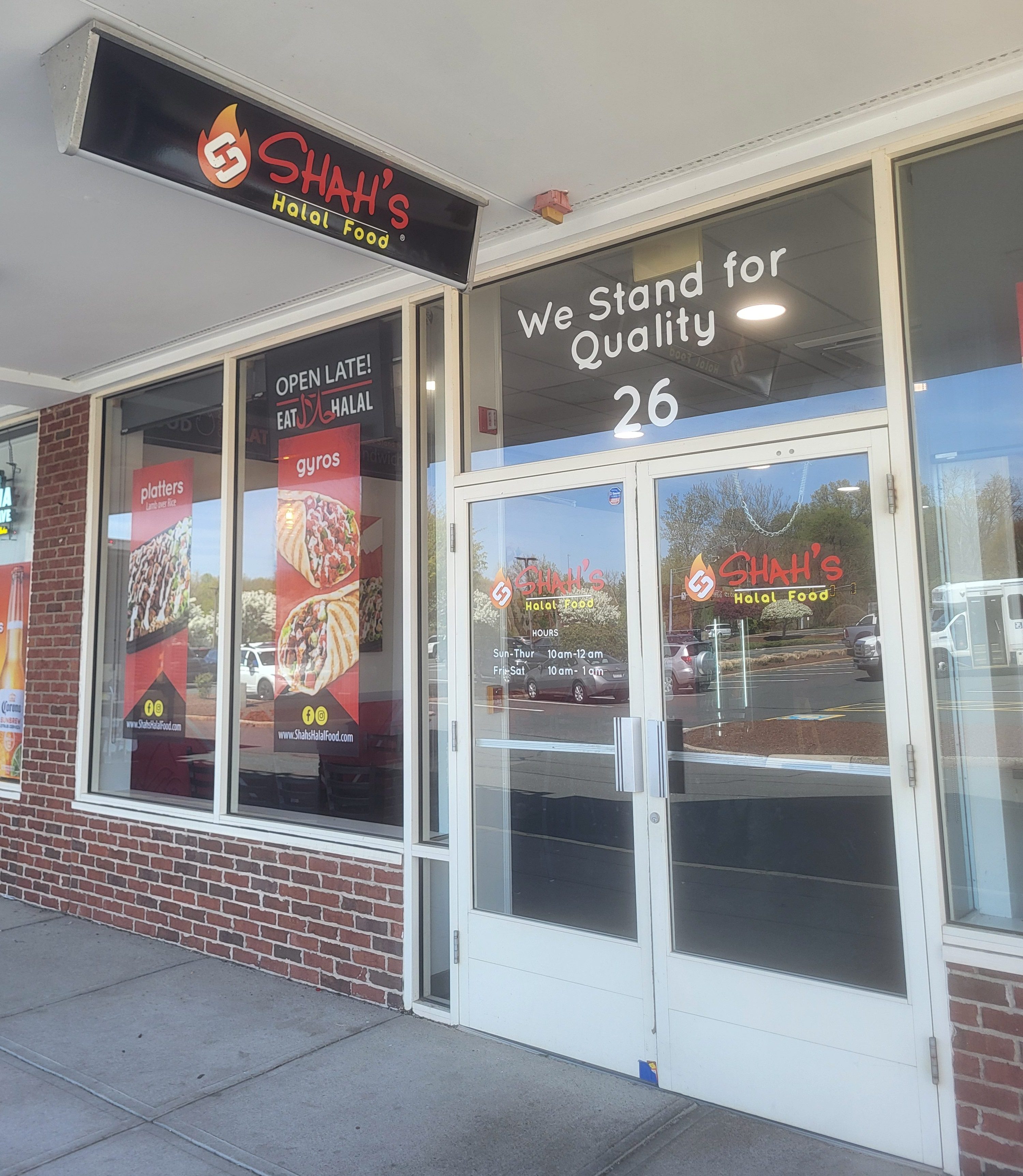
I was on the hunt for lunch. Wedged in a small shopping plaza, next to a few gas stations and a Stop & Shop in New Britain, Connecticut, a sign labeled “Shah’s Halal Food” hung above a glass door; It matched the rest of the glass wall that showed its contents from the outside. Next to the bright, red lettering was a roaring fire symbol, and underneath, their slogan: “We stand for Quality.” Inside, three of the walls were vibrant red, and the wall on the far right was a painted mural of Shah’s first New York food truck. Black tables and chairs clung to the left walls, leading to a small hallway that contained the bathrooms. The very front displayed vegetables, lamb, chicken, and several colored sauces down an assembly line of stations. At the end of the counter table was the cash register and a stack of plastic to-go containers.
The worker, dressed in his all-black uniform, asked whether I wanted their signature white sauce. I had made it clear that I don’t come to halal places often. He convinced me, and I obliged by ordering a bowl of rice, chicken, cucumber salad, and potato crisps. That worker, named Vee, mixed everything in the bowl like an “Arab salad.” According to him, I wasn’t allowed to pay either, because the point of a sample was that it was free. Though I wouldn’t be allowed to indulge until after sundown, I appreciated the gesture.

That is exactly what I had done the previous month; I waited to eat. This was the common Muslim practice of fasting. Ramadan is a religious holiday when Muslims do not eat or drink (even water) from sunrise to sunset. That cycle repeats for a month; a constant hunger creates a physical and mental challenge. Salads at the dinner table never taste as savory and salty-sour as they do during Ramadan, nor do the special cheese-stuffed desserts melt on the tongue. In childhood, the reasoning for this fast was simple: to feel a kinship with those who didn’t have the luxury of knowing when their next meal would be. Whether that reason was poverty or genocide, those individuals would have to wait longer than sunset for their food, if they got it at all. The goal was respectful, and the logic was sound to me. So, I waited to eat.
Beyond the fasting, this monthlong holiday means more to the faithful, for it’s the holiest time of the year. It’s suggested that demons have left the Earth during this period, and Muslims were especially protected from sin for that reason. Best of all, if you could pray when the moon twinkled just the right way, on a singular, undetermined night Muslims called “Laylat al-Qadr,” all your prayers would be answered, so long as you prayed that night. It’s magical, it’s rewarding, and it’s missed when it’s over.
When I was around seven, my heart was crushed when I learned that only people of my religion could see heaven. Even then, I knew that it came at the expense of some people I loved, or would love in the future. I couldn’t bring myself to buy that; the doubt started there. Information would reach me, but I wouldn’t digest it as fact, nor could I toss any belief away entirely. I grew frustrated that I couldn’t prove or disprove any aspect of Islam, and I was hungry for answers.
Because Islam is the “correct” religion. The Qur’an is strict and sure of itself in ways that the Bible and Torah may not be. Less translation over the centuries has made it the most accurate, pure word of any of the monotheistic gods. Its consistency over time made it superior in the Middle Eastern quota. The culture around me treated the five pillars of Islam as a fact:
- Faith: Believe or go to hell.
- Prayer: You must pray five times a day to the direction of Al Kaaba, where God resides.
- Charity: You must help give back if you’re able to.
- Fast: You must partake in resisting your appetite during Ramadan.
- Pilgrimage: You should visit Al Kaaba for the opportunity to wipe your sins and start holy and anew.
I had failed the most significant pillar more as I aged. It seems that God did not love unconditionally, and some sinners were damned for hell. It also didn’t make sense that sinners and bad people would exist in a world where a God could have easily not made them. For this religion to work, you would have to balance two inconsistencies at once:
- In Islam, everything you have ever done has already been written out by God. There’s nothing you will do that has not already been decided in advance.
- In Islam, all actions are either holy or sinful, and you’re being graded on these actions as you “choose” to make them.
The confusion of this haunted me; Did people have free will or not? Was God angry at the things we’d done, even though it had been predetermined? Was that fair? I didn’t think it was.
“What’s American food? It’s McDonald’s . . . people have figured that it’s not healthy. [Here you] get rice; you can sauce it up, and you get your salad [and] it doesn’t put you to sleep.”
Ramadan was the ultimate reminder to be a good Muslim, an act that felt like it bore no real reward upon finishing it. Even as I got old enough to fast for myself, I never regarded Ramadan with great enthusiasm; it was merely a ritual that had to get done. I wasn’t like my younger cousins, who would practice with having breakfast and no other means of sustenance until dinner. Fasting was a fun challenge for them. I, t however, to feel close to the less fortunate and to gain a sense of gratitude that I was able to eat all three meals on the regular.
In truth, I wasn’t sure what compelled me to hunt out answers now. It could’ve been the fact that Ramadan shared its season with the early blooms of springtime, or the fact that the sun set sooner and made it easier. Or maybe it was because I had been through something wicked this year, and if it weren’t for the way Ramadan worked, I would’ve half-assed the way I coped with it. Islam’s strictness had worked in my favor. It felt like tough love, the same way baby birds get tossed off their nests to fly and navigate the world.
My rage and sadness subsided, and it was replaced with curiosity. This was how other Muslims felt most of the time. Like them, I continued my search. I sought out answers on the site that nurtured the beliefs of Islam the most.

I met with Iman Ibrahim in mid-April at the Islamic Association of Central Connecticut in New Britain. Like Shah’s Halal Food, the glass entrance invited light inside the lobby. This mosque reminded me of the TARDIS in Doctor Who, the way it felt bigger on the inside. Though the lobby wasn’t large enough to fit a front desk, the male and female musallas (places of worship) occupied half a football field each. Only the male musalla was visible, showing boys and men kneeling and chatting on a thick, red carpet with swirling designs. On the other side of the lobby was a black spiral staircase encased in red bricks, contrasting the white wood used for the rest of the structure, and an elevator sat between it and the musallas.
The second floor led to a hallway that had a glass wall matching the entrance below it, showing the thin road as cars whizzed by. Down the hallway were two areas: the party/gathering rooms, filled to the brim with long sets of white tables and chairs, and the locked-up classroom, where children would learn the basic principles of Islam.
“This year, we noticed our community getting bigger on both sides,” Imam Ibrahim explained, a keffiyeh wrapped around his neck. He sat in a chair at a long table in the party room. “We have seen different races, the variety in our community, Alhamdulillah. We have seen Moroccan, Yemeni, Sudani, Bengali, Pakistani.” Based on the general turnout of the people who had come to his mosque this year, he has estimated a population of five hundred to six hundred Muslim families in the area.
Community is the reason he established this mosque. It is Ibrahim’s duty to deliver the sermons and remind his people of their Muslim rituals. During Ramadan, he directs outreach with nearby events like soup kitchens, and builds the foundation on what it means to be a proper Muslim.
“As an Imam, I will take the chance to try my best to clarify the message of Islam. At least, I would try to, if I wouldn’t convince him, do the bare minimum: to eliminate and remove the sentiments that he or she has.”
Ibrahim’s words sounded gentle, calming, and accepting. I was a child again with my feet dangling off the ground, learning something mystical about our holy land and God-gifted Earth. His cadence lacked the hostility I had been used to. He reminded me that not all religious leaders make shaming others into their own beliefs their mission. His haven focused on peaceful education, and more importantly, the inclusion of different people.

I returned to Shah’s Halal Food after the end of Ramadan to speak with Vee. This time, I paid for my dinner. He credited freshness as the reason for the wide growing success of Shah’s Halal Food, as compared to general fast food options.
I returned to Shah’s Halal Food after the end of Ramadan to speak with Vee. This time, I paid for my dinner. He credited freshness as the reason for the wide growing success of Shah’s Halal Food, as compared to general fast food options. “What’s American food? It’s McDonald’s, it’s Wendy’s, or it’s some Subway, right? Now, people have figured that it’s not healthy. So what do they prefer? They want their carbs. They get their rice; a good, good, good quantity of rice. They get their protein, and you can sauce it up, and you get your salad. So that’s like a complete meal. It’s not too greasy. It doesn’t put you to sleep.”

They didn’t use vinegar to spice their food. Instead, it was always seasoned with salt, garlic salt, and a mix of Middle Eastern and Indian spices. The meat for Shah’s franchises was brought in from the New York headquarters, where the meat was extracted and cut in ways that are certified halal. For meat to be considered Halal, it has to come from animals that did not die in cruel manners; chickens and cows can be killed right away, while pigs would suffer slowly, and therefore cannot be eaten. The halal meat came already marinated, with Shah’s corporate standard operating procedure having a smaller amount fried every two hours. That way, each batch could run out and be replaced with fresh meat. (The only exception was fish, because all fish are already halal to eat). The entire business had begun as a food truck in New York that expanded in the span of a few years.
I purchased a bowl of chicken, rice, and salad, along with a shawarma sandwich and six-piece halal chicken nuggets. I bought more food than anticipated. I was already on my way to a friend’s dormitory, and in the spirit of Ramadan, I shared my food. My friend had never had a shawarma sandwich before, but apparently always wanted to try it. At the first bite, his glasses shone from the light beaming from his eyes. “DAWG!” He exclaimed, loving the spiced naan bread, shredded lamb, and pickles.
The sun was setting outside as I recited my bad day to him in between bites of my bowl. The chicken was tender, the spices bursting with rich flavors. The cucumbers were refreshing and blended seamlessly with the contrasting hints of garlic within the white sauce. I had waited to eat it until I was with company, and for that, I was rewarded with a taste more flavorful than if I had eaten alone. I still have qualms with organized religion and feel like it bears the potential to do more harm than good. But there’s a unity religion offers that cannot be stripped from it; it can connect and teach human beings principles in a hands-on way. In the hustle and bustle of everyday life, the world had itself one more believer of something undefined, but present.
Feature Image: Shah’s Halal Food / Photo Credit: Maya Zureiqi
I love how I can hear your voice on the page–the moon twinkling just the right way. Always a light wit and such good in-the-field reporting. Terrific story.