

It’s 1986. Shopping malls are growing rapidly worldwide. Shiny crystal chandeliers, elegant skylights, massive fountains with large spray jets shooting water into the air, velvet-lined walkways, and planter boxes with large, carefully trimmed plants cover the space. Eighties pop stars serenade shoppers: Madonna, Michael Jackson, and Whitney Houston. The mall was the ultimate spot for shopping, with stores like Gap, Footlocker, RadioShack, Macy’s, and Sears. Food courts full of franchises like Orange Julius, Hot Sam Pretzels, and Sbarro. Arcades were packed with young teens, pockets full of change, spending the day at the retro arcade cabinets like Pac-Man and Asteroids. Thousands of malls like this existed across America.

In the late 1980s and early 1990s, rapid growth led to an oversaturation of shopping malls by the late 1990s and early 2000s. It was a slow demise. By the early 2000s, most shopping malls were outdated and poorly maintained, losing the battle to cost-conscious shoppers who preferred boxstores, which grew like wildfire in prior years. The 2008 financial crisis accelerated this shift, causing numerous store closures and bankruptcies as consumers reduced their spending.
Many blame the downfall of shopping malls on the rise of online shopping, a new business model built up in the late ‘90s. The emergence of online shopping had taken its hold. Amazon, having launched in 1995, became a big success. It was a revolutionary idea, starting out as a small online bookstore run by Jeff Bezos out of his Seattle garage. With the click of a button, consumers shopped in their pajamas, receiving their products in a day. And it wasn’t just Amazon taking down the shopping world.
“The decline of the malls really starts in the 90-s, mostly because we built so many of them that they started to cannibalize each other.”
“Newspapers like to jump to the headline that it’s online shopping, but that’s more like the nail in the coffin than it really is the beginning. The decline of the malls really starts in the 90s, mostly because we built so many of them that they started to cannibalize each other.” Ellen Dunham-Jones, a professor and architecture program director at Georgia Tech and coauthor of Retrofitting Suburbia: Urban Design Solutions for Redesigning Suburbs, told WIRED in 2019, “I think that there’s a lot if that social function is being substituted with online. The former Surgeon General declared that the U.S. is in a loneliness epidemic, and much of this he blamed on substituting social media for really being in social spaces.” As the world changed, shopping malls struggled to keep up.

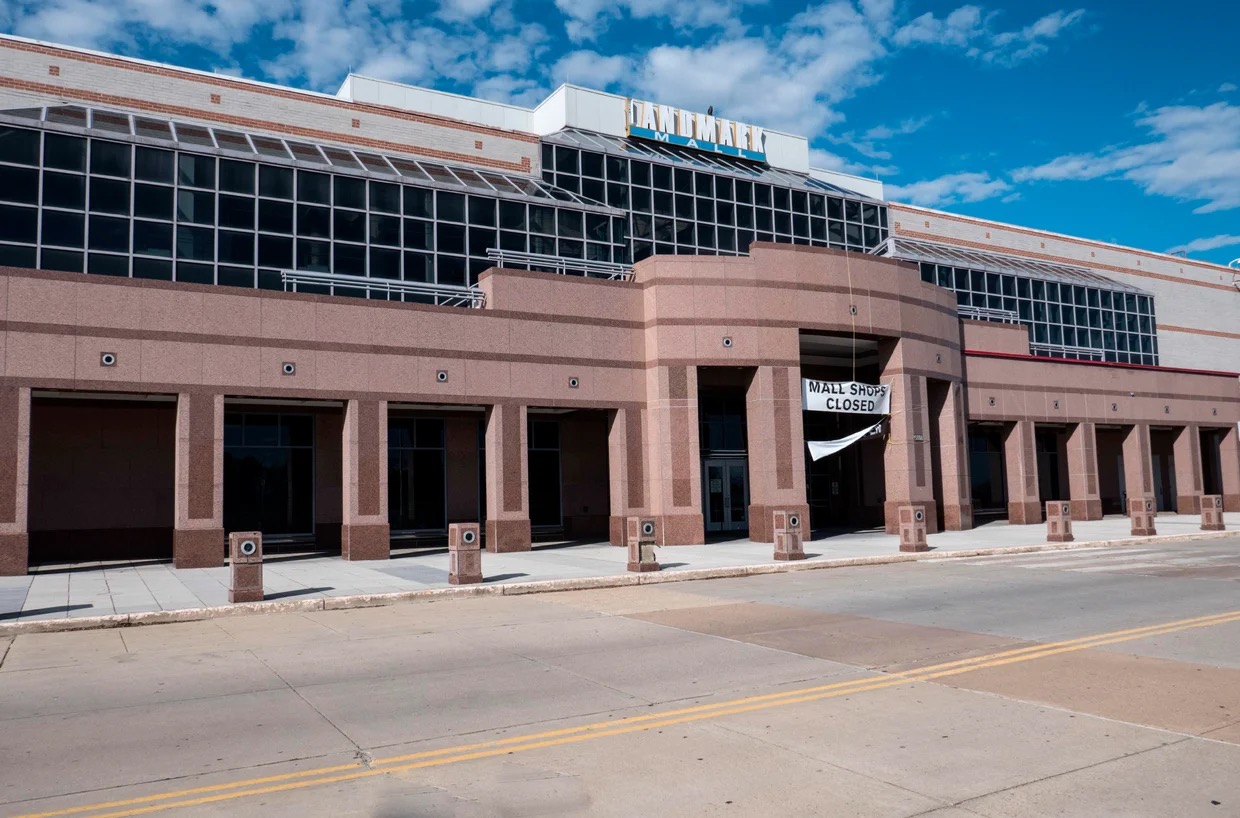
The closure of these spaces created significant real estate, investment, and civic problems. Many shopping malls, such as the Mall of America, a large supermall located in Minnesota containing more than 520 stores, a theme park, and an aquarium, are still holding strong, but the difference is clear. The enormous size of a shopping mall, roughly four-hundred-thousand to a million square feet, makes maintaining the physical structure alone a daunting task. Empty fountains, once filled with water, now sit empty and cracked from wear. Old, empty advertisement frames hang, exposing concrete underneath. Nature reclaims forgotten buildings in cities that are too cost-conscious and lack buyers. Old buildings sit chained off, covered in graffiti and rubble. There were roughly 1,500 shopping malls in the U.S. in 2005; Today, that number sits closer to 700, representing a decline of more than 50 percent. A lot of these spaces stand still, frozen in time, and barely running on the little store revenue and consumer traffic they have left, while others have permanently closed their doors, leaving hulking buildings for cash-strapped towns to maintain.
A million square feet of space doesn’t just go unnoticed, and many mall owners and political leaders debate about what to do with all the empty space. Developers have had to become creative when it comes to repurposing what is essentially a massive empty box surrounded by miles of concrete. In recent years, the spaces have moved beyond their retail roots. In 2022, New York Governor Kathy Hochul retrofitted an empty mall into an affordable housing complex for senior citizens. That same year, developers turned Alderwood Mall in Lynnwood, Washington, into Avalon Alderwood Place, a three-hundred-unit apartment complex complete with underground parking. Housing isn’t the only solution, though. Since the pandemic, many of these spaces have been transformed into healthcare centers, as many of these empty malls are located in neighborhoods lacking accessible medical care.
Other solutions are more business-oriented, and involve public private partnerships directed toward economic revitalization. In October, 2025, General Dynamics Electric Boat, a nuclear submarine manufacturer, purchased the nearly eight-hundred-thousand square foot Crystal Mall in Waterford, Connecticut. The company hopes to repurpose it for engineering training, software development, and office use after renovation.“You build a mall in a location where you can track a lot of people from a lot of areas,” Electric Boat President Mark Rayha said at a press conference announcing the purchase in 2025, “So doing this here is a great opportunity.” The company is expected to house around twenty-four-thousand to twenty-five-thousand workers in the new development, and is expected to bring major economic benefits to southeastern Connecticut. With twenty-five-thousand workers in such a large space, many will be spending a lot of time in the area, most likely moving there. As a result, property value may rise as there are more spaces for those workers and local businesses to thrive. The cost of redeveloping these spaces is significantly lower than it would cost to rebuild from scratch, reducing environmental waste that would otherwise be an issue.
Even so, it’s not all downhill for America’s shopping malls. Gen Z, which makes up about 20% of the U.S. population, has helped revitalize the in-person experience. Craving the social experience, Gen Z consumers are turning stores into viral destinations through social media. Young influencers stand in crowded stores in shopping malls, holding up clothing for the camera. They share their locations on social platforms, such as TikTok and Instagram, prompting viewers to return to malls.

This trend has encouraged mall owners to renovate their spaces, building more socially friendly spaces that appear aesthetically pleasing and entertaining. “Shoppers between the ages of 18 and 24 bought 62 percent of their total general merchandise purchases in stores last year. Shoppers ages 25 and older, by contrast, made 52 percent of their purchases in person,” according to Circana, an American market research and technology company. Kate King of the Wall Street Journal reported, “Gen Z’s retail-spending growth is outpacing all other generations, according to data firm NielsenIQ, with the generation’s global annual retail spending expected to exceed $12 trillion by 2030.”
Gen Z is making a big impact on American shopping malls. Today, in malls like the Danbury Fair Mall, located in Danbury, Connecticut, groups of teenagers drift beneath artificial skylight panels, pausing every few steps to photograph themselves. Large, brightly colored advertisements cover the walls and rotate every few minutes. Popular restaurants line the building, such as The Cheesecake Factory, Longhorn Steakhouse, and ShakeShack. Teens move through the mall, carrying drink cups and shopping bags. Chappell Roan, Olivia Rodrigo and Sabrina Carpenter play through the overhead speakers. Bowling alleys, indoor carousels, and popup workshops like the Art of Scent Freedom Perfume Making Brunch transform the mall into more than just a place to shop.
Feature Image: Photo Credit: Education Images/Getty Images
0 comments on “The Mall of Tomorrow: The Future of America’s Shopping Experience | Katherine Soda”