

On the fourth floor of the New Museum, pink carpet runs from wall to wall, and a blond girl hovers just above the shag. A black mini dress clings to her frame, silver sneakers fixed in place as wires hold her aloft. Her eyes are closed. Her chin rests lightly on a glass plate, reflecting the metal of her left arm.
The stillness of her body feels suspended in space and time, caught between human vulnerability and mechanical intervention. The longer you look, the less clear it becomes whether she’s resting, frozen, or preserved.
If she ever opens her eyes, she’d see the original prototype for ET, reaching out his finger in a glass containment box across from her.

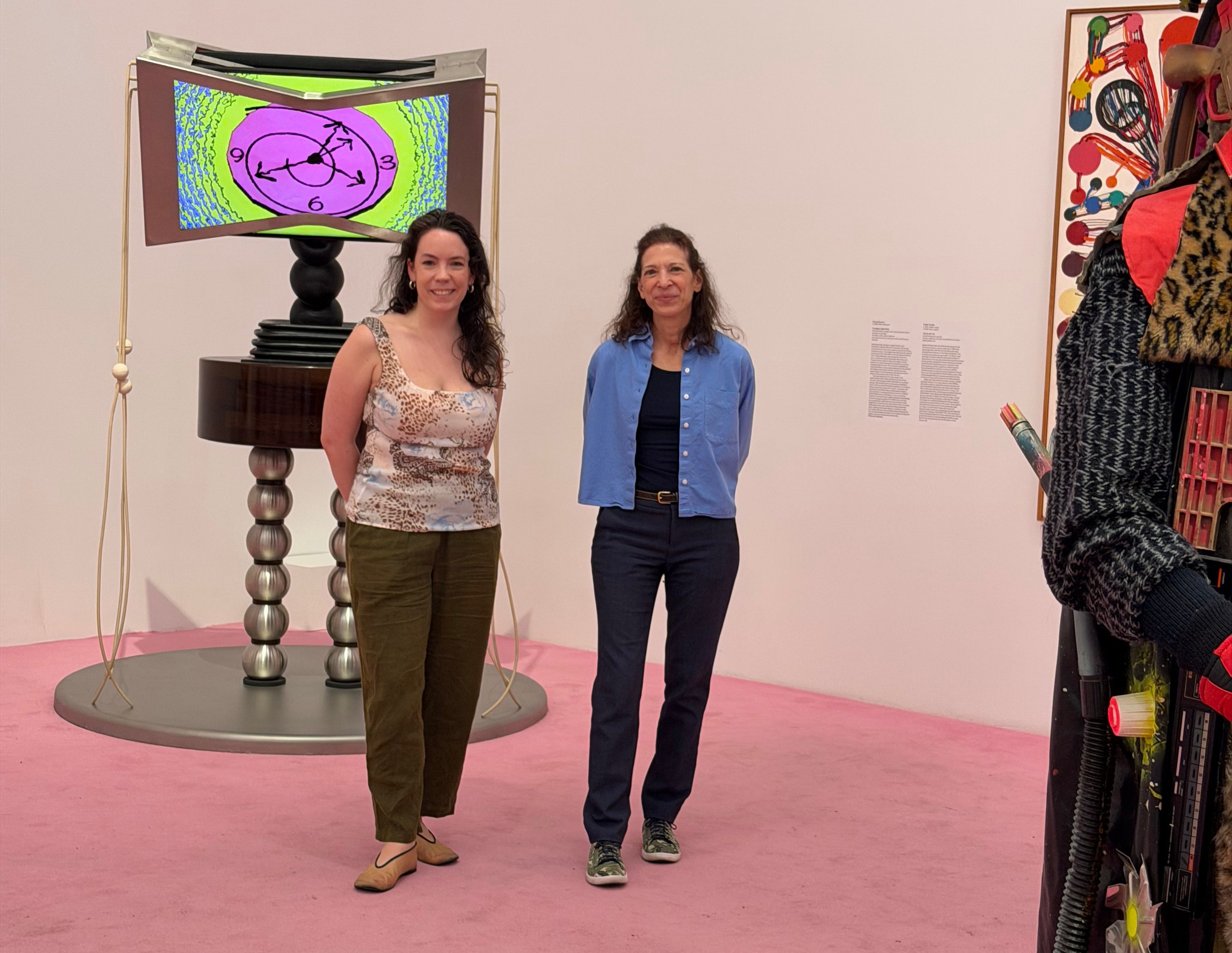
“This blond sculpture right here was installed with pink carpet, and that was one of the artist’s strong asks: that it be installed the same way it was previously,” says Sarah Morris, director of communications at the New Museum. Styled in a blue floral cheetah-print tank top, olive trousers, and tan flats outlined in black, Morris gestures toward the work. “The curators took that and ran with it and made the entire room pink carpet.”
To the blond’s right sits a creature prototype by Swiss artist H. R. Giger, known for his biomechanical designs in the Alien franchise. The juxtaposition is intentional. The Xenomorph’s form, with its fusion of skeletal and industrial elements, pushes the viewer to question where the body ends and the machine begins.
“A lot of new commissions and very recent work are paired alongside historic artwork,” Morris says, “speaking to what it means to be human, especially in moments of major technological or societal change, and how artists have responded.”
Rather than presenting the future as something entirely new, the exhibition suggests that each generation has confronted its own version of technological uncertainty, and that these concerns repeat and evolve across time.
“When a curator brings things together, they’re looking at that in relation to the other artists and bringing things together in a whole new art form.”
Down Prince Street toward Bowery, the Lower East Side of Manhattan suddenly opens, steel and light cutting through the rows of brick and tenement walls. Rising 174 feet over the island, the New Museum reads less like a building than a work of contemporary art itself. Its original six stacked, offset boxes of mesh and glass, designed by SANAA, an architecture firm, now stand alongside an $82 million expansion by OMA’s Shohei Shigematsu and Rem Koolhaas in collaboration with architectural firm Cooper Robertson.
Extending the institution’s futuristic silhouette into lower Manhattan, the structure feels deliberately out of time. The asymmetry contradicts traditional architectural expectations, reflecting the museum’s refusal to conform to conventional norms. Even before stepping inside, the museum makes its stance clear: This is not a place organized around preserving the past but one oriented toward what comes next. Yet oddly enough, it is through the past that the future is understood, as the museum folds earlier responses into present-day discussions.

Founded in 1977 within a one-room gallery space on Hudson Street, the New Museum’s mission is to fill a gap in the cultural landscape of New York City by supporting underrecognized and experimental artists. Its founder, Marcia Tucker, a former curator at the Whitney Museum of American Art, believed there should be “a new kind of museum” dedicated to the art of the present, rather than the preservation of the past.
“Marcia was doing crazy things with contemporary artists, and it wasn’t fitting into the museum landscape,” explains Diane Vivona, vice president of advancement. Dressed in a pale blue button-down layered over navy pants with her green sneakers and brown belt, Vivona adds, “Museum people thought [these exhibitions] were too radical and really pushing the boundaries of what sculpture means.”
From Founder Marcia Tucker to longtime director Lisa Phillips, the New Museum has maintained a women-led directorial team, a rarity within the art world. That legacy extends through Morris and Vivona, who help shape the museum’s identity and future trajectory. In 2014, the Association of Art Museum Directors (AAMD) and the National Center for Arts Research (NCAR) conducted a study on gender gaps in art museum directors, finding that the majority of museums with budgets less than $15 million are run by a female director, while the reverse is true for museums run by a male director. In a field long defined by traditional hierarchies, the New Museum has instead aligned authority with experimentation, suggesting that innovation extends beyond what’s shown within its walls.
Vivona points to Tucker’s early curatorial risks as symbolic of that ethos. “Famously, she worked with Richard Tuttle. He had a string as his sculpture, and people were like, ‘What is that?’ You know, they were used to these massive major steel sculptures that were happening at the time, and she was like, ‘This is sculpture as well. It’s conceptually just as rich as the other things that were happening.’”
“I am an architect, so the architecture is quite impressive.”
Now, with a major expansion, the museum is once again reinventing itself. Developed over a decade by artistic director Massimiliano Gioni, the inaugural exhibition, New Humans: Memories of the Future, spans across three floors and includes more than 230 artists and over 700 objects, ranging from historical and contemporary responses to technological and social change.
“One cool thing about the show,” Morris says, walking up the atrium stairs to the second floor, “is as much fear as we might have around new technologies, it’s interesting to see artists from throughout history reckoning [with] whatever the new technology was of their day, and fears and opportunities around it. It kind of makes me more hopeful about our ability to navigate it correctly.”
Hope, however, exists alongside unease, as many works throughout the exhibition interrogate systems of control, surveillance, and the objectification of the human body. Even as technology promises progress, it raises questions about who benefits and how it reshapes human experience.
After being closed for twenty-six months, the museum is attracting art patrons and curious visitors to the stunning new space. On the third floor, Fredia and Justin, twenty-year-old NYU international students, were pulled in by the museum’s reopening as a chance to experience something new in the city.
“We heard it just recently reopened, so [we] just wanted to take a walk, get a glance of it,” Fredia says. “It’s so interesting. My favorite part is actually the fifth floor. It is really cool about the architecture and near-future stuff.”
The New Museum unfolds floor by floor, its open design guiding the way. Exhibition spaces extend from the lobby through the fourth floor, while upper levels are dedicated to production, experimentation, and civic programming. The fifth floor sustains NEW INC, a purpose-built workspace for chosen artists, designers, and technologists working across disciplines. The sixth floor contains an artist studio space for the museum’s residency program. The seventh floor features two skyrooms, reserved for public programs and special events. Together, this structure reflects the museum’s commitment to art as something produced, tested, and continually redefined.
Everything is done purposefully, from the architecture to the exhibition installations.
“Any genuine artist is making a work in a particular time period that is reflective of what they’re thinking about in relation to culture and their environment,” Vivona says. “When a curator brings things together, they’re looking at that in relation to the other artists, and bringing things together in a whole new art form.” Curators are artists in their own right, bringing these pieces together to pull out threads of movements and ideas across time, especially in this exhibition.
That curatorial interpretation is evident throughout the museum. In Mechanical Ballet, Simon Denny, a contemporary conceptual and installation artist from New Zealand, showcases a white sculpture, based on an imagined cage designed to optimize Amazon workers’ efficiency, standing at the center of the space. Opposite is a wall of time-lapse industrial photographs showing factory workers’ hands fitted with lights. Together, they trace shifting systems of labor and surveillance across a century. Elsewhere, the galleries move from body politics to postcolonial visions of humanity, and onward into hypothetical urban futures.
Wandering on the second floor in a dark gray t-shirt and round, clear glasses, Joan Camps, visiting from Chile while on his honeymoon, was attracted first by the building itself.
“I am an architect, so the architecture is quite impressive,” he says, “it was kind of a surprise for us because we are not so much into a contemporary art museum, but the exhibition is very interesting, so I was quite happy that I paid the $25.”
The ambition embedded in the building is that architecture becomes part of the exhibition experience instead of a neutral vessel. While the floors seamlessly move through, the $82 million development extends SANAA’s stacked geometry outward, increasing transparency and vertical circulation as a curatorial narrative. The 50 percent increase in exhibition space blurs the boundary between old and new by making the friction between SANAA’s earlier six-box structure and the new extension feel like one in steel, glass, and movement.

Standing by the long check-in desk in the lobby, Tim “the Bat” Gourdine, the New Museum’s senior security officer, surveys the crowd coming in and out of the building. Dressed entirely in black, from beanie to sneakers, he moves through the building with a quiet presence. A Batman-logo fanny pack sits at his waist, matched by a pin on his jacket, with a yellow unity pin resting just below it.
“I’m a huge Batman fan,” he states, “that’s my alias here. They’ll call me on the radio, ‘the Bat.’ I’m just quick. I see everything.”
For thirteen years, Gourdine has learned and relearned the rhythms of museum etiquette, watching visitors move through the shifting exhibitions, while protecting the artwork and observing the ever-changing habits of crowds. Before joining full-time, he worked events in the building through a contract company, until staff he knew encouraged him to apply.
“The atmosphere, the people [make me stay],” Gourdine acknowledges, “Everyone has their quirks, but the staff here is really cool, and they make everyone comfortable. It’s not like most businesses where somebody’s on your back. They let us be ourselves.” He offers a rare view from the gallery floor. He observes how visitors move through space, how they behave and respond, and how museum culture has changed over time.
“You have to understand, with a lot of guests, some don’t know you can’t touch the art,” he adds. “Real aficionados [are] very quiet and slow talking or silent like they’re in church.”
Gourdine knows the museum ecosystem inside and out, and it shows in the way he speaks. Though stationed inside one of New York’s most forward-looking institutions, Gourdine’s art tastes remain classic.

“[My favorite piece is] the Salvador Dalí on two. I take that any day of the week,” he says. “Some of [the technological exhibition] is cool, but I’m old school. I like art. I like my paintings. I like my sculptures.”There is something fitting about “the Bat” guarding a museum obsessed with the future. Positioned between tradition and change, Gourdine becomes part of the same system the building creates, one that depends on watching, moving, and being seen.
In the stacked, shifting volumes of the New Museum, attention itself becomes the medium: how visitors look, how guards observe, how artworks are seen. Even the architecture participates in this circulation, turning movement into curatorial logic.
Shelter by Klára Hosnedlová (2026)

There is no distinction between where the original structure ends and where the new building begins. Czech-born artist Klára Hosnedlová’s sculpture Shelter stands against the first set of atrium stairs, the first artwork to command attention. Morris stops at the bottom of the stairs. “It’s really enormous, as you can see. It’s based on textiles. Hemp and other natural fibers that are woven together by Czechoslovakian and Slovakian traditional textile workers.”
Created specifically for the museum, the installation marks the artist’s inaugural museum presentation in the United States. Designed to be fully site-specific, Shelter, like the museum around it, resists fixed boundaries between past and future, structure and spectacle. Watchful and unmistakably New York, the museum is less a space for preserving art than an environment where perception is produced.
Featured Image: Sarah Morris and Diane Vivona on the fourth floor of the New Museum / Photo Credit: Nadab Rana
0 comments on “The “New” New Museum: Where the Future Collides with the Past | Gabriella Page”